Wednesday, February 20, 2013

16 Things I Love about Gram

Gram on her wedding day.
I smile when Paul says
he sees her in me.
I'm compiling memories of Gram from my cousins, and I just get overwhelmed every time I read what they remember. Gram was the most amazing person I've ever known. We all knew it, but I'm only now seeing what she really meant to us.

But how can I convey that to you guys, who never met her?  All I can do is try and let you meet her through our memories:

  • She always gave personalized gifts. My cousin Lauren has always been into fashion, design, clothing, and knitting, so Gram bought her a vintage copy of the Reader's Digest sewing book (the best sewing book out there, and a required textbook at Lauren's school...one she hadn't bought yet!). A second example:  my sister and I were obsessed with paper dolls when we were little.  So Gram picked out a blonde-haired-blue-eyed doll for my sister (Cinderella) and a brown-haired-brown-eyed doll for me (Sleeping Beauty), so our dolls would look like us.  Other years, we got calendars made with family photos or a compilation of the family history research she'd done.  
  • She read.  Like a fiend.  She devoured books.  She gave me my first batch of steamy romance novels when I was a college freshman.  My sister and I stayed with her for a week every summer growing up, and one of the first things she did was take us to the Escalon library.  One week--that was way too much time not to have a book in hand.  When she was hospitalized, at the end, she made sure to tell someone that the Jack Reacher books were in a cubbyhole in the trailer.  You know, because it was unthinkable that they wouldn't get passed on so someone else could enjoy them. 
  • She was there when the chips were down.  When my cousin Coby was pregnant and on bed rest, Gram took care of her.  Gram brought her a yogurt and cinnamon toast with peanut butter for breakfast, explaining that it was her favorite breakfast because it would keep her full for so long.  Coby says Gram hated her couch with a passion, but would just sit there and not complain, reading a book while Coby rested.
  • She always wore navy and white.  No matter the season or the occasion.  She knew what she liked and she stuck with it.  
  • She didn't swear.  Instead, she just said "jish."  (She probably wouldn't like how often I swear...Gram, I can try and work on this.)
  • She never complained.  About anything.  Her parents lived to be 99 and 93, and she took care of them as they aged, through numerous broken bones and convalescences with infinite patience.  And this was when she was in her 60s and 70s.
  • She knew how to have a treat.  Hers was a scoop of vanilla ice cream in her coffee.  Or a biscotti.  As a kid, Gram's freezer had all sorts of treats. I remember Flaky Flix the most.  This was stuff we would never have at home, but it was always at Gram's because she was, well, Gram.
  • She gave us half and half to put on our cereal.  Who does this?  It's ridiculously rich and decadent, but that's what breakfast at Gram's included (if she wasn't serving cinnamon rolls, scrapple, or French toast). 
  • She gave the perfect advice.  Fashion? Turquoise jewelry never goes out of style. 
  • She only wanted us to be happy.  This one was particularly meaningful to me, since I eloped and married a guy she'd met once. Once. My best friend refused to speak to me after I did this, and hasn't spoken to me to this day (6.5 years later), but Gram accepted him immediately with a hug and said, "Welcome to the family."  When she found out my husband loved Chee-Tos, she made sure to have a fresh bag for him every time we came to visit.  Every time.  Just because she knew it would make him happy.  My husband said to me, "She was more of a grandmother to me than anyone in my family has ever been."  That was Gram.  Even strangers would feel like family until they actually became family.   
  • She was adventurous.  Hiking, fishing, camping, traveling all over the world.  You name a place, she'd been there.  You name a road in California, she'd gone down it.  She and Papa had a fishing boat and spent summers in Telegraph Cove, British Columbia.  Killer whales jostling the boat couldn't stop them from fishing, canning, and smoking salmon.    
  • She expanded our horizons.  My cousin Marcie remembers playing Life and doing puzzles with Gram. Gram always let her be the banker.  Gram also played "office" with Marcie and taught her how to pay bills and write checks.  Gram also had a ridiculously good collection of coffee table books and pointed us toward ones that matched our interest.  For me, it was the companion volume to Ken Burns' The Civil War.      
  • She had a better social life than pretty much anyone I know.  She had tons of friends and social events.  And she volunteered.  And donated blood.  And just gave her time and attention to anyone who needed it.  Everyone knew her.  Everyone loved her.  She was bright and happy and fresh and eager and everything you want to be at the end of the day.  I will never be her equal.   
  • She was generous.  She took all of us cousins shopping for our birthdays.  We got to go out and spend $35 on whatever we wanted, and then have lunch with her.  My cousin Marcie remembers how, in true Gram fashion, she never counted the tax as a part of our birthday money.  How awesome is that?  
  • She made fun things even funner.  By adding empty L'eggs pantyhose eggs to our horde of plastic easter eggs, she made a good time even better (thanks, Sar, for that memory).  At Christmas, pretty much already the funnest time ever for a kid, she'd hide oversized presents with clues written in our Christmas cards. We had to dig in closets or scrounge in the garage to find our gifts. The big ones were usually furniture or luggage or something useful that she knew we needed to have.  Gram was always going to make sure you had what you needed.  
  • She got it.  She just got it.  We had a drawer of dress-up scarves that we liked to play with.  Sometimes, we'd wear them like we were supposed to, around our shoulders or on our heads.  But most of the time, we took turns tying each other up and seeing who could get free.  Gram laughed in that amazing laugh of hers, the one that came from deep inside because she meant it.  Other parents or grandparents might wonder if the kids were all gonna turn out to be future miscreants, but Gram let us do it.  She knew we were just being kids. 
There are 8 million reasons why I love her.  I can't even get all of them down on paper here.  My brain isn't big enough or good enough to capture it all.  I miss her so much.

Monday, February 11, 2013

When the Personal Is the Professional

As a writer, you are your brand.  As a self-published writer, your brand is the most important thing you have.  But what happens when that smiling, professional, upbeat, media-friendly you isn't any of those things?

My grandma is dying.

Any minute, I could get the call.  I saw her one last time and I told her I love her, and then, because there was nothing else for me to do about it, I had to go back to work and back to real life.  But I can't think of anything except how the world is suddenly lacking in security.  If anything was ever wrong, I knew I could go to Gram's and all the bad stuff would go away, at least while Gram fed me lunch. In case of apocalypse, my mom always said, "Go to Gram's."  The ranch is somewhat remote, and would presumably have been safe (and defensible) from anything from Communists to zombies.

But it was the people who made the ranch a home base, not the zip code.  Now, the last of those people is about to leave forever and I don't know what the hell else to do or think about.  Made-up stories haven't felt this stupid to me in a long time.  

When you are your brand, it's a luxury to go radio silent on social media.  But I have to, for a few more days.  I can't think of anything to say that would enlighten you or help you or generally advance the conversation about writing. I will try to fix that, once I figure out where my next apocalyptic safehouse is going to be.

Thursday, January 31, 2013

Writers on Twitter: Something's Not Right Here

So I signed up for Twitter in January, and have been making efforts to follow writers, publishers, self-publishers, and anyone connected with the biz. It's been less than a month, but I'm already seeing two distinct camps in terms of the kind of content writers on Twitter are putting out:

(a) Rampant self-promotion, as in the following: 
  • Review for MY BOOK: "Amazing, best book ever, love love love, buy buy buy" #tag #tag #tag
  • "Your life will suck unless you read this book" MY BOOK TITLE HERE amzn.link.buy.my.book
  • "TITLE IN ALL CAPS HERE" ORDER YOUR COPY TODAY!! PLEASE RT!! #TAG
 (b) Helpful or interesting articles about writing, contests, etc.: 
  • Twitter writing contest!  Enter here: bit.ly.link.to.something.useful
  • Neil Postman Award: The author of the chosen poem will receive $500
  • What (TV Show name) Can Teach Us About Creating Character Archetypes
I scan tweets every hour or so, and it seems that at least 60% of them are shoving someone's miraculous one-of-a-kind book down my throat.  Guess what?  I saw that tweet the first time.  And the second.  And the third.  I know your book was reviewed by Kirkus.  Hell, I can probably quote the review verbatim by now.  Does it mean I'm going to buy the book?  No.  It means I'm going to unfollow you because all you can add to my day is the umpteenth all-caps mention of your book title.   

Do these people ever get tired of pasting the same messages into HootSuite or SocialOomph? Does this kind of guerilla marketing actually work?  

If these writers are selling books and making money, more power to them.  It just seems like the point of screaming into the ether is to have something to say.  "GIVE ME YOUR MONEY" isn't really the message I want to be remembered for. 

Sunday, January 13, 2013

Billy Joel and High School: One of These Really Needs the Other

I plugged a flash drive into my car's stereo system the other day, and a golden oldie cycled through yesterday:  Billy Joel's "We Didn't Start the Fire."  You guys know this one, right?


It made me wonder...do kids these days even know what the heck this song is talking about?  Studebaker, Rosenbergs, h-bomb?  How many graduating seniors could take the lyrics of this song and present even a rudimentary knowledge of the people or events they're referring to?  I watch segments like Jay Leno's "Jaywalking," where people can't even identify Washington DC on a map, or tell the difference between Washington and Lincoln.  How in the hell is this song going to mean anything to someone who thinks the Gettsyburg Address was delivered during World War II?

Granted, I might not even have been able to parse all the references in this song in my senior year, and I was up to my armpits in AP classes.  But it seems like a killer idea for a history class final or project.  How awesome would it be to hand out lyric sheets to a class and have them learn what actually happened in the last half of the 20th century?

Plus, the song still kicks ass, so you'll always be entertained.  Take a personal challenge and see how many of these places or events you know.

Sunday, January 6, 2013

Book Writing Strategy, Part 2: Trim Like You Mean It

If you've been following the saga of my current work in progress, you know the first draft strategy involved hauling ass to write 400 pages.  410, to be exact.  I finished in a somewhat burnt-out stage, but theoretically impressed at the fact that I'd done it all in about 9 weeks.

The second step is a rigorous chopping of those 410 pages.  I'm almost through with the first editing pass, with one more to do after this.  The stats are a little surprising: I can't believe I've already cut this many words!  I'm still 45 pages from the end, and I know the end sucks, which is why I've been avoiding it.  But up to this point, here's the blow-by-blow for the first draft and this revision:

First Draft
Final word count: 117,531
Final page count: 410

Second Draft (almost done):
Word count: 93,550
Page count: 345

Total words chopped: 23,981
Total pages chopped: 65

Now, you might wonder why I'm bothering to chop so damn many pages.  The answer is threefold:

(1) Anytime you can chop, you should.  The best fiction is *always* told in the fewest number of words and sentences.  You want your story to skip along at a tight pace, without extra words cluttering things up.  If your attention wanders at all while re-reading, something's not right.  In my experience, it usually means the characters aren't getting to the point.  Or there isn't enough tension.  Cut the parts that make your attention wander, or figure out why it's wandering.  Is it just too long?  Does it fail to advance the plot or offer a new perspective on your character?

If cutting is painful for you (as it is sometimes for me), here's a tip:  I keep all the lines that got axed in a text file, always open as I'm revising.  That way, everything I cut is still there...I could add it back if I discover that it really did add something I don't want to let go of.

(2) Don't forget that revision includes addition as well as subtraction.  There are two or three scenes I think I need to add to this book.  I'm picking apart the main character's motivation, and I don't think she's been pushed hard enough to defend it.  There are at least two scenes I need to add, where both her friends and her family question the path she's taking.  I think readers are going to have the same questions, so I need her to defend against their disbelief.  The problem is that, with a ms that's already well over 117,000 words, you have no room whatsoever to add.

Ruthless chopping gives you the breathing room you need to step back and figure out what's missing.  Then, you have all the space in the world to add material where you  need it, without the pressure of thinking, "Shit, I can't make this scene more than 3,000 words."  Don't limit yourself--free yourself by cutting what doesn't belong before you go back and add what does belong.  This works especially well after your first editing pass because as you read the book a second time, you'll have a better feel for where your story needs to be shored up.

(3) It forces you to dig deep into your story.  What's really necessary?  This is where you think about plot and character on a deeper level than pure language and the cutting of unnecessary words, like in step 1.  Think about scenes and chapters in the big picture of your theme and what you're really trying to say.  Does that scene add to your theme?  Does it set up the next plot complication?  Does it tell us something we didn't already know?

If a scene's sole purpose is to show that one character is a pain in the ass for your hero, ask yourself--is that something we already knew?  Can you combine the important words or events from the second instance of that pain-in-the-ass character to the first, so we get one powerful confrontation or instance where we're told that this character will be a thorn in the hero's side?  If we've already established this, we don't need to beat a dead horse.  The next time we see this thorn, he or she should be actively plotting the hero's demise, not merely annoying him or her once more.

There are eight million reasons to revise.  I'm just covering a few of them here to get you started.  I've said it before, but I'll say it again....revision is the most important thing you can do for your writing.  It's where your craftsmanship shines through.  Your plot might be inspired, but unless your writing and editing support that vision, it's not going to win over agents, editors, or your future readers.

My husband shakes his head when I mention spending hours on a single paragraph, but that's the kind of attention you have to give to crucial scenes.  Read them over and over and over.  Inspect every word and make sure it's earned its place on the page.  Any time you stop reading, whether because of a strange reply from a character or a phrase you have to read twice to understand, stay stopped.  Go back over it and tweak it eight ways from Sunday until it's so smooth you can read over it without a snag.  This might mean you devote an hour to one conversation, or have three versions that you have to decide between.

This is how it should be.  I am firmly convinced that this is the only way you can make sure you stand out from the crowd.  If you can give that much love and attention to your work, editors and agents will notice.  And so will readers.    


Sunday, December 23, 2012

Merry Christmas to All

The Wiltz family
Christmas tree, 2012
Is everyone's Christmas shopping finally finished up?

As of last night, mine is. I took the one-stop-shop approach this year, and if you know me, you can probably guess where that one stop was made.  Let's say there's gonna be a lot of glass clinking in the car on the way to Gram's house tomorrow.

I have to say, I'm looking forward to some pickled herring tomorrow night. My dad's side of the family is Swedish, so we celebrate on Christmas Eve.  Dinner usually consists of Swedish sausage and mashed potatoes.  Last year, we had some pickled herring out as an appetizer, and it was pretty tasty.  I'm really hoping to see that jar on the counter again.

Yes, that is a stuffed
Napoleon Bonaparte I use
as a tree topper.
On Christmas day, we celebrate with my mom's side of the family.  It usually consists of a couple of games of Aggravation, which is pretty much our family game.  If you've never played this game, it's a great excuse to metaphorically kick the crap out of your friends and relatives.  We wail on each other, knocking marbles off the board with reckless abandon.  It's a little known fact that I sold my soul to be able to roll a 6-6-1 at will.  I'm working on a post that will map out some metaphors that use Aggravation as a way to get better at writing, all part of the lineup I'm getting ready for 2013.

But that's work talk, and this is a time to relax.  Writers need a few days off, too!  So enjoy Christmas, enjoy the great food and company, and eat as many servings of dessert as you possibly can before you throw up.  There will be plenty of time for discipline and exercise in the new year.

Tuesday, December 11, 2012

Glowing Album Review: Ellie Goulding, Halcyon

Cover photo from
Ellie Goulding's album, Halcyon
In case you haven't noticed, the past few posts I've made have been of the Scrooge variety:  stuff sucks.  So I wanted to be sure and post something that's not negative just to show you guys that I don't hate everything.

I am absolutely LOVING Ellie Goulding's new album Halcyon.

It is awesome writing music, driving music, singing music, everything music.  I put it on when I'm alone, I put it on when the hubby and I are typing away, I put it on anytime I want to hear music, actually.  I'm addicted.  I have tried to listen to other things, but always end up switching back to Halcyon.  It's crack, apparently.

Prior to being blown up on the radio and played every two seconds, I kind of liked "Lights."  I kind of liked her first album.  It was all right, decent background music, but didn't have any standout tracks that I would put on a mix tape, for example.

Halcyon is different.  I read that it's a breakup album--and it shows.  This is a good thing.  The lyrics are deeper, and some of them are the kind that reach inside you to stab you in the heart and steal your breath.  The melodies are haunting and catchy at the same time.  The mood is melancholy but somehow triumphant.

It's a weird place to be...acknowledging despair and sadness, but also the fact that things will get better.  That's what makes this album so much fun to listen to.  The rhythms and melodies lift you up, but then when you listen to the lyrics, you realize, holy crap, this girl is in despair.    

Track 2, "My Blood," is a standout.  It has a thumping, rhythmic background with chanting that sounds almost Native American.  The chorus takes flight out of the low, bass rhythms of the chorus.  This is where her silvery, elfin voice creates a beautiful contrast with the beating drums.  Her lyrics bring it all together:  "The waves will break every chain on me / my bones will bleach / my flesh will flee / So help my lifeless frame to breathe."  The metaphor of the song is that the breakup of a relationship results in blood lost.  She sings about "all the blood I lost with you," and seeing the color of her blood on walls and rocks.  If you've ever been through a bad breakup, you know that's exactly what it feels like...a slow murder.

I'm also a sucker for a depressing ballad, and there are two killer ballads back-to-back toward the end of he album.  Track 9, "Explosions," and Track 10, "I Know You Care," made me stop what I was doing and remember to breathe.

"I Know You Care" is probably going to be one of my desert island songs.  It's just Goulding and a piano as she sings about the turning point in a relationship where you know it's going wrong.  She sings, "You were like home to me / I don't recognize this street" to explain the way her lover has changed toward her.  Then, she follows up with, "Outside the cars speed by / I'd never heard them until now."  It's one of those writerly details that amaze me on this album.  She's pinpointed that moment, that very moment when the world around you changes and suddenly you see and hear things you didn't before...and it's not a good thing.

Late in the song, as she describes the nuclear fallout of this relationship gone wrong, she sings, "I know it wasn't always wrong / but I've never known a winter so cold / now I don't warm my hands in your coat / but I still hope..."  Her voice tilts up on "hope," and you know there's a whole world contained in the phrasing of that one word.  It's so beautiful and it breaks your heart.  Four lines later, she ends the verse with, "Why can't I dream? / Why can't I dream?"  It's the bleakness of a soul-shattering breakup without the strained, treacly, sickly sweet voicing that ruins many pop and R&B ballads.

The Brits are really kicking ass in terms of albums I'm loving right now.  The last album I had in heavy rotation was Emeli Sande's Our Version of Events.  These smart women are writing songs that feel true, without the dance-pop bluster that American radio hits seem to rely on.

If you haven't heard it, try to find a quiet place to listen via YouTube.  I can't recommend it enough.  Plus, I read in an interview that she loves to run (me too!) and her writing idol is Haruki Murakami.  This may be a full-on girl crush.

Sunday, December 9, 2012

Ridiculously Comprehensive Movie Review: Anna Karenina

I've been waiting patiently for a couple of weeks now to see the new Anna Karenina adaptation.  The early signs were good:  Keira Knightly as Anna, a merchandise tie-in with Banana Republic, and a storyline created by, oh, only one of the greatest writers of the nineteenth century.  All signs were go.

So yesterday, with a bribed husband in tow and a whiskey flask in my purse (source of his bribe), I plunked down my $20 and sat down in a dark, smelly theater to see what Joe Wright had managed to put together.

I now wish I had spent that $20 on more whiskey.

This movie was sort of like the Russian version of Sofia Coppola's failed Marie Antoinette movie from a few years ago.  Pretty, but without a soul and largely miscast.

Here's the basic plot (no spoilers here):  A married woman, Anna Karenina, begins a flirtation with an attractive young cavalry officer named Vronsky.  The two engage in an affair, and complications ensue with Anna's niece Kitty (who wanted Vronsky for herself), Anna's husband Karenin, Anna's young son Seriozha, and society in general, who frowns on Anna's behavior.

Now, this pains me to say, because I love Keira Knightley and no one's smoky-eye makeup ever looks better on the red carpet.  However, something was off about her in this role from minute one.  Something was off about the entire movie, too.  Let me see if I can explain this a bit better.

Weird Thing about this Movie #1: The Staging
The movie has a strange staging effect.  It takes place on a strange rotating stage, as if the director wanted us to have the feel of a stage play.  Curtains rise and fall, painted set pieces drop into the background, and people walk out one door only to walk in another door right beside the first, in order to indicate a change of scene, place, and time.  It feels contrived rather than interesting.  It does not add to the intimacy of the story, nor does it advance any of the characters.  It's basically a wasted gesture that just ends up being confusing.  Plus, not all of the movie is done this way.  The scenes with Levin, a character who lives in the country, are actually shot in the country, not on the revolving stage.  So what's the point?  Why do this for part of the movie, if you're not going to do it for the whole thing?

Weird Thing about this Movie #2: The Dramatic Pauses
If you can get past that, there are a few more artsy-for-the-sake-of-being-artsy touches that also have that contrived feel.  Characters pause like statues at particular points so we can see Anna and/or Vronsky moving around in the scene.  Like the ornate theater-style sets, though, it's unnecessary.  This plot and these characters happened in a society thick with togetherness.  Separation like this only destroys the intimate, everyone-knows-everyone-else's-business effect that the plot needs for the ending to be believable.  Wright captures this feel once, when he flashes onto the faces of disapproving Russian society matrons as they grimace and smirk at the misbehaving Anna.  I kept thinking, "I know there's a movie that did all this better.  Oh, that's right--Dangerous Liaisons."  Pretty much everything Anna Karenina wants to be was already done...and done better...in Dangerous Liaisons.

Weird Thing about this Movie #3: No Development/Reason for Love Story
The whole point of this story is to create sympathy for Anna, a woman who does something wrong.  She has an affair, but we're meant to sympathize with her impetuousness, her willingness to risk everything for love, her ability to go after what she wants and flout society's stuffiness to do it.  None of that actually happens here because the director didn't take the time to make the love story believable.

Anna and Vronsky basically fall in love during one strange ballroom dance scene.  They've exchanged a few words and glances prior to this, but it's not anything beyond a mild flirtation.  But somehow, once dance, and we're supposed to believe mad passion has been inspired.  The actors can't quite pull this scene off (director's fault?  not really sure here), and the screenwriter really needed to have another scene or two where we see Anna struggling with this.  As it is, she seems to smile at Vronsky, dance with him, breathe heavily for a minute, and declare herself in love.  There's very little struggle, and very little reason why Anna would fall for Vronsky.  His hairdo is horrific, and he's kind of stuck on himself.

The problem here is that if we don't believe these two are madly in love, we won't believe what comes afterward--Anna's mad struggle to free herself from her husband and set up shop with Vronsky, despite Petersburg's social ostracism.  It seems weird that she would do this for this man.  In the book, all of this is given time to simmer and develop (the benefits of a nearly thousand-page book, I guess).  But in the movie, we have to buy life-altering mind-numbing passion in one scene.  It's not enough, at least not the way it's written, staged, and directed here.

Weird Thing about this Movie #4: Keira Knightley Seems Off as Anna
I thought this would be a slam dunk.  I mean, Keira Knightley is born to play tormented historical heroines, right?  Of course.  So why is this different?  I think it has to do with this being a Russian book.  There is something deep and dark and churning in the Russian soul that I think this movie missed entirely.  Keira Knightley played Anna as happy and playful before her affair with Vronsky.  I could have been okay with this, if that playfulness were shown as part of some deep emotional tide running within her.  Instead, it seemed like she was an overgrown child, having more fun at the kids' table than with adults.

Once she hooked up with Vronsky, she became a total stage-5 clinger, to make a nifty Wedding Crashers reference.  She was shrill and shrewish, instead of fatalistic and soul-consumed.  I now want to see Vivien Leigh in the role, because I'm thinking she might have been better at the whole soul-consumed thing (what with her depression and bipolar issues and all).

Basically, this Anna seemed like a silly girl instead of woman who let her sense of fatalism control her destiny.  It made the character silly and the movie silly.  I'm trying to think of who else might have been able to play this role

Weird Thing about this Movie #5: Vronsky's Hair
Oh my God, Vronsky's hair.  I don't care if Russian dudes in the 1880s actually looked like this.  Now, it just looks silly, like the Masterpiece Theater version of Gene Wilder's hair.  Give the guy some regular hair, please.

Overall, I feel like this was a wasted opportunity.  It was pretty, for the most part, but wrong.  Just wrong.

Friday, December 7, 2012

Ridiculously Comprehensive Book Review: The Romanov Conspiracy by Glenn Meade

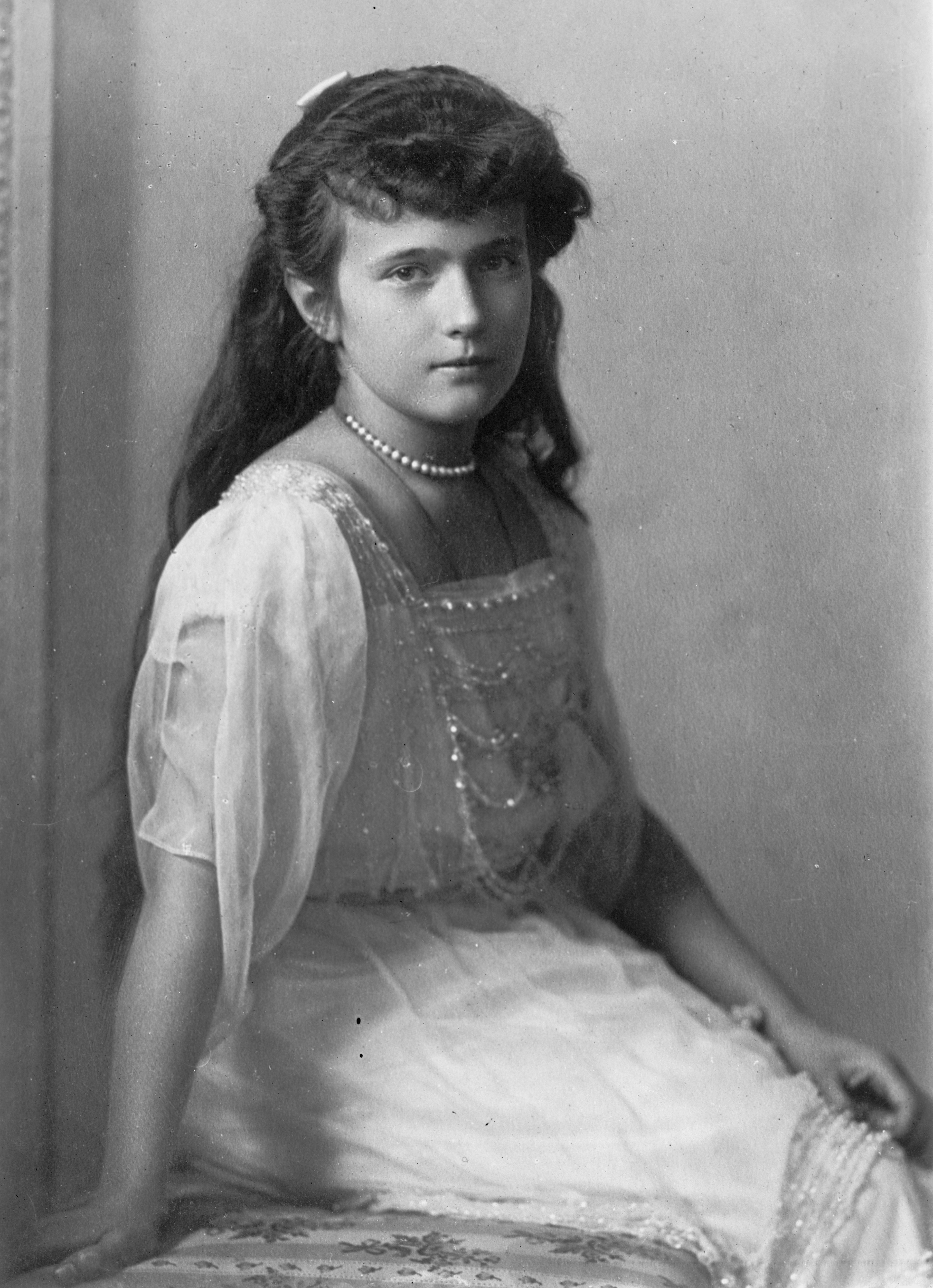
Grand Duchess Anastasia,
or, as Meade calls her,
"Princess Anastasia."
By Bain News Service,
public domain,
via Wikimedia Commons.

We all love a good thriller, right?  We love it even more when it combines history, mystery, and exotic settings.  That's what The Romanov Conspiracy by Glenn Meade promises on the jacket copy.  Does it deliver?  Let's find out.

Full disclosure mode: I’ve also written a Romanov-based thriller, so I’m slightly biased, not to mention hyper-sensitive to the treatment of the subject.  So instead of addressing the plot, I’m going to focus on the elements themselves: the characters, the writing, the pacing, etc.      

Let’s start with the good:

1.  I was turning the pages pretty quickly in the first quarter to third of the book, thanks to the interesting characters Meade gives us, particularly two men named Andrev and Yakov.  They're from opposite sides of the tracks, one a Tsarist soldier and the other a die-hard Red.  Their paths cross as children and then again as adults.  Another interesting character, named Sorg, is an American spy in Russia who interacts with the Tsar's family in good times and bad.  Each of these men are intriguing and given enough personal background and motivation so that you start to feel for them.  A murdered younger brother, a murdered father, an unrequited childhood love carried into adulthood…there’s some good stuff here.  Their emotions feel real, and I got sucked in.     

Now let’s address the bad:

1.  This book is too damn long.  It’s almost all set up and very little payoff.  The extremely long, drawn-out scenes work well in the beginning of the book since you’re just getting to know the characters.  But once you look at the page number and realize you’re on page 300 and the rescue of the Romanovs has barely begun, it gets frustrating.  This is where an editor comes in handy.  Maybe Howard Books can’t afford one, or they can and that person was busy with other things while this book was in production.  All I know is there is no reason for this book to be 515 pages.  It could have been 300, easy.

2.  The frame is lame and nowhere near as present as the jacket copy makes it out to be.  If you read the jacket copy, you’ll think most of the book is about Dr. Laura Pavlov, a forensic anthropologist working in Russia who stumbles on clues as to what really happened to Anastasia, the youngest daughter of the Romanov family, supposedly murdered in 1918.  The story starts and ends with Dr. Pavlov, but she’s present about as much as the main title and end credits are present in a movie.  This book takes place in 1918 for 98% of the page total. I still would have read it knowing this, but it would have been nice to have an honest representation on the jacket copy. 

The epigraph also promises that the book is going to connect Anna Anderson to this conspiracy/rescue attempt.  That was really all that kept me reading once the plot bogged down in the 200-400 page range.  Unfortunately, the only mention of Anna Anderson in relation to the titular conspiracy comes at the very end of the book, tossed away in less than a page, with a vague mention of a secret brotherhood being behind her seemingly uncanny knowledge of royal life at the Russian court.  

Really?  No one called B.S. on this?  

SPOILER ALERT.  Also, the book purports that Anastasia escaped the slaughter of Ekaterinburg, that Anna Anderson was a decoy sent into the world and trained by a secret brotherhood that tried and mostly failed to rescue the Romanovs.  Who these secret brotherhood members are is unclear.  But the book also never explains who it was that was found in the earth near the rest of the Romanov family.  It’s one thing to claim the body isn’t Anastasia because of unreliable DNA testing.  It’s another to say it wasn’t her because the real Anastasia survived, without offering a plausible explanation as to how a person who shared DNA with the rest of the family ended up in the exact same spot as Alexei yet we’re not supposed to believe it’s Anastasia.  That’s quite a coinky-dink, isn’t it?

And we’ll finish with the just-plain-ugly:

1.  The writing.  It’s bad.  Like, bad.  It’s clumsy and badly in need of editing.  There are lots of adjectives.  Lots of brand names, as if that suffices for a description of a thing.  The verbs are trying a little too hard in places like this:  “….I snapped open the leather briefcase on my lap and plucked out a file”.   "Snapped" and "plucked" in the same sentence just feel overwraught.

In other places, the storytelling is heavy and ponderous, like Andre the Giant trying to tiptoe:  
  • “I still recall the peaty wood smell when as a child I would leaf through the family album, filled with the faded images from another world.”
  • “Some events in our lives are so huge in their impact upon us that they are almost impossible to take in.” 
  • “It felt intensely cold.”  
I read sentences like this in my freshman year of college, in the intro to creative writing.  To be fair, I wrote some of them, but I also learned to realize I was wrong. 

A lot of the dialogue is unnatural and stilted, like the following line spoken by an old woman remembering the past:  “Of all the royal family, Anastasia was the  most rebellious, the most sparkling.”  Does anyone…would anyone…ever speak this sentence out loud?  Who says “the most sparkling”?

2.  George V refers to Nicholas II as Nikki.  It’s not the nickname I disagree with, but the spelling.  Why use “Nikki” as a nickname and not spell Nicholas with a “k”:  Nikolas?  It makes no sense.  There is no consistency, and it drives me bonkers.  

The same thing happens with Russian royal titles.  Meade calls Nicholas “tsar,” which is the Russian equivalent of “emperor.”  Yet instead of using the Russian title of “Grand Duchess,” Anastasia is referred to as a “princess.”  No one even halfway interested in Russian or Romanov studies would ever refer to her as Princess Anastasia.  Even the kiddie cartoon Anastasia gets it right and calls her Grand Duchess.       

Overall, I really wonder how the author’s previous novels earned “rave reviews in the New York Times and the Washington Post.”  The craft just isn’t there, and I would have expected that to be recognized by the Times, if not the Post.  

Maybe that’s the real conspiracy.  

Wednesday, November 21, 2012

A Brief Note on the Semicolon: Why the Freak Can't People Get This Right?

What the heck
is so confusing
about this?
I've noticed something about the semicolon:  No one knows how to use it anymore.

I don't understand the reason for this.  The rules have not changed.  It's not like the whole analog-to-digital TV thing, where everyone in the country was told there was going to be a massive change and notified during every commercial break for months in a row.

How is this singular piece of knowledge being lost?  How is it that a dot and a curved line mystify so many writers, editors, and proofreaders?

Let's consult a few sources:

  • According to the APA and the Chicago Manual of Style, you should use a semicolon to: (1) separate two independent clauses that are not joined by a conjunction, and (2) separate elements in a series that already contain commas.
  • In an article for the New Yorker's website, Mary Norris relays an apt descriptor from a style book put out by an English firm:  "A semicolon links two balanced statements; a colon explains or unpacks the statement or information before it."
  • According to Merriam-Webster, a semicolon is a punctuation mark "used chiefly in coordinating function between major sentence elements (as independent clauses of a compound sentence)."
By no means is this an exhaustive list, but it's a start.  Now, let's focus on the ways people use it to link their thoughts incorrectly.  Here are a few examples I dug up at work:

SEMICOLON EFF UP #1:
Wrong:  Despite the fact that kids are well fed, exercised, and socialized there is still a problem that persists; oral health.
Corrected:  Despite the fact that kids are well fed, exercised, and socialized, there is still a problem that persists: oral health.  
Why the first one is wrong:  A semicolon connects two complete but closely related thoughts.  "Oral health" is NOT a complete thought.

SEMICOLON EFF UP #2:
Wrong:  You can tailor much of the desktop environment; for example, the background window.
Corrected:  You can tailor much of the desktop environment--for example, the background window.  
Why the first one is wrong:  The portion of the sentence after the semicolon is not an independent clause.  If you spoke it aloud, no one would have any clue what your context is.  Plus, there's no verb.  So there you go.

SEMICOLON EFF UP #3:
Wrong:  My favorite things to do in Hawaii are surf; hiking; and sailing.
Corrected:  My favorite things to do in Hawaii are surf, hike, and sail.  
Why the first one is wrong:  You mean aside from the non-parallel verbs?  SEMICOLONS ARE NOT COMMAS.

I beg of you...please pay attention when you use semicolons.  If you're in doubt, don't use one.  Much like nuclear missile launch codes, semicolons should never be deployed without complete and utter confidence in one's decision-making abilities.  If you're certain you want to use them, a few minutes of online research will give you great examples of what to do or not do.  Then read this, just because it's funny.  

In closing, I have to post a quote I found, written by some dude named Henry Marie Joseph Frederic Expedite Millon de Montherlant who wrote, "One immediately recognizes a man of judgment by the use he makes of the semicolon."  Too true, bro, too true.