Showing posts with label angst. Show all posts

Sunday, December 14, 2014

8 Lessons Learned from Taking 2 Years to Finish 1 Novel

Book Cover: The Red Road by Jenni Wiltz
What, me, self promote? Perish the thought.
I'd never be so brazen as to tell you that it's
available for pre-order on Amazon or Kobo.
Official release date: January 26, 2015.
So if I don't write a post for five months, will anyone notice? It's been eating at me - the time I've spent away from blogging about reading and writing. My last post was in July, for goodness' sake. I had lots to say, but no time to say it. But now that The Red Road is finished, I feel like a weight has been lifted. It's cliche, and as a writer, I should do better, but that's exactly what it feels like. 

This two-and-a-half-year journey is finally coming to an end. I started writing The Red Road in May of 2012. As of December 2014, it's done. As in file name "TheRedRoadFINALFINALNOREALLYIMNOT
KIDDINGTHISTIMEFINAL.epub." It's formatted, tested, and ready for pre-sale on the interwebs. Now it's time to wrangle some marketing and take stock of what I've learned. And, boy, this is the book that's taught me the most. Here's some of what I've learned.


Lesson #1: Writing about real life is hard. In thrillers, it's easy to come up with a quip and have the bad guy shoot someone to get out of a tough spot. In a book about high school girls? Not so much. These characters don't have the spatial freedom grown-ups have. I had to give up the easy answers that thrillers and paranormal tales had to offer.


Lesson #2: Writing about real people is hard. I don't think I will ever do this again. Characters based on my mom, dad, and sister are in this book. And I did bad things to them. I stripped every character of safety and left the worst versions of themselves exposed. This is much easier to do with people you're not sitting across the table from at Thanksgiving.


Lesson #3: You have to care about something a hell of a lot to work on it for two and a half years. There were times I cried, shut off the computer, and told the hubby I needed to find something else to do with my life. I never actually wanted to give up, but it felt good to say. It gave me the freedom to come back the next day and say, "Well, since I'm giving up, I guess it would be okay to tweak this one thing just to see what would happen." Sometimes that was enough to take the pressure off and shut down my inner editor, who is a world-class psycho hose beast. 


Lesson #4: Don't go into a book with a social or moral agenda. When I started this book, I was fresh out of grad school. I wanted to write a literary novel, a novel with purpose. I picked out all the social ills and evils of my hometown and forced them into the story. Guess what? The first draft was embarrassing. Preachy. Overwrought. Lacking connection with the characters. And, worst of all, boring. I deleted most of it.


Lesson #5: Presentation matters. File size, epub2 versus epub3, fleurons, dropcaps, embeddable fonts, line height, media queries...holy crap, I didn't know what I didn't know until I decided not to rely on Smashwords or Microsoft Word. My brain hurts. But this is the best-looking book I've ever put out. Now I'm kind of ashamed of all prior efforts.


Graphic: Purple nametag that says, "Hello, My filename is TheRedRoadFINALFINALNOREALLYIMNOTKIDDINGTHISTIMEFINAL_VERSION3_USETHIS.epub"

Lesson #6: Never give up. Be as stubborn as you can. The day that ends in failure? It's just today. Tomorrow's different. You might spend weeks trying to figure out the dumbest thing (why the eff images come out huge in Adobe Digital Editions when they look great in the InDesign file). And you might feel really stupid and small because you can't "get" something that most people don't even bother thinking about. But if you keep working at it, you'll unlock it. And then everything you do from here on out will be right and you'll know why. It won't be an accident.

Lesson #7: Take the time you need. This goes hand-in-hand with Lesson #6. Any sane person would have said, screw this ninth draft. Screw this stupid image that won't size right. I can't spend any more time on this. Those Write, Publish, Repeat guys have serialized a twice-as-long sequel to War and Peace in the time it's taken me to figure out what CSS is. They don't write ninth drafts. And they're making money. So why should I do it? 


You should do it because you care about your work and your name and the story you're telling. If you care more about production time and the number of titles you can crank out in a year, you and I are different and that's okay. I want to take my time. I want to savor the process and learn every part of it. Delayed by 10 weeks to learn InDesign and eBook coding? Fine by me. Delayed by 3 months to add new character arc and revise book again? If it makes the story stronger and will leave readers more satisfied, I'll do it every damn time.


Lesson #8: Stay true to you. The writing world is full of posts and books that offer strategies, productivity tips, and shortcuts. Hell, I'm writing a tip-filled post right now. You have to know which are going to help you and which are not. You have to know what you believe in and why. And you have to know your own strengths and weaknesses. All advice must be filtered through your self-awareness. I'm still learning how to do this. But I'm getting better every day.


You are the architect of your own success. Good luck out there.

Thursday, January 2, 2014

8 Things I Never Knew about the Donner Party


Meme: Donner Party? I thought you said "dinner" party.
I spent this weekend doing nothing but reading Ordeal by Hunger, by George R. Stewart. It sat on my shelf for 10 years after a chance purchase in a Truckee bookstore. Now, I live about 70 miles from Donner Lake and can see that forbidding ridge of the Sierras from my living room. Then, a couple weeks ago, we had snow. This is not supposed to happen--we're only at 1,500 feet. But it did happen, and our pipes froze and our driveway iced, which is why I think I finally plucked this one off the shelf.

Going in, I knew what most people know: they were pioneers en route to California, got snowed in at Donner Lake, and died. I think at some point I must have known there was cannibalism involved. I was under no illusion that this was going to have a happy ending, but holy mother of God, I had no idea it was this bad. There's a lot I didn't know or didn't remember.

There's a lot no one tells you.

This is by no means an exhaustive summary. It's more a jumbled recollection of the moments that pierced the cold, cold veil of my shriveled heart.

1. They were pretty much beaten before they ever reached the Sierra. Just getting to California had exhausted them in every way. To get their wagons over the Wasatch mountains, they had to stand in front of the wagons with axes in their hands, making the damn road yard by yard. They had to cross the desert beneath the Great Salt Lake, a more fucked up route than other travelers because the Donner party took an ill-advised southern cutoff that wasted a shit-ton of time. Suffice to say, when someone tells you the next water is three days away but really it's seven, you're going to have a bad time. Blame that douche-bag Hastings, who told them, "No sweat. My cut-off is a piece of cake," and then ditched them, leaving behind notes that lied to them about how far away the next water was.

2.  They didn't like each other very much. It would have been a shit trip under any circumstances. But in addition to the navigation issues, they also lost a bunch of cattle to the Paiutes, both through thievery and general marauding. No blame, just a statement of fact. All told, by the time they got to the eastern slope of the Sierra, they were tired, hungry, in need of supplies, and lacking tolerance for each other. If you and your sibling got on each other's nerves in the car as kids, imagine going on a six-month car ride where you had to build the road for the car by working in harmony with said sibling.  I'm pretty sure Mother Teresa would have needed at least one time out.

3.  They weren't all stuck in one cabin, tent, or even general area. There were three distinct cabins, with the two Donner families a whopping five miles behind them. When they got to Truckee Lake (now Donner Lake), it was about Halloween...and it started snowing like a mother-you-know-what. It didn't stop. They tried twice to get those big-ass wagons up and over the pass, but it just didn't happen. So they dropped back down on November 4 and realized they had to make camp on the eastern side of the pass until spring.

They set up some primitive cabins along the lake, with the Jacob and George Donner family groups about five miles back.  The party had always been segregated by family groups (the Breens, the Donners, the Reeds, the Murphys, the Kesebergs, etc.), but now those segregations etched themselves in stone. Contact between family groups was generally limited to requests for help, which were usually ignored or fulfilled only grudgingly. There were 60 people: 19 men, 12 women, and 29 children, including toddlers. The men bore the brunt of the work--gathering firewood, attempting to hunt, etc. Suffice to say, it fucking sucked.

Bad Luck Brian meme: Invited to a party for the first time--the Donner Party
At first, they had some food: a bear, a few remaining cattle, mice, and hides they boiled and used for soup. But when that runs out, what happens? Can you sit around a dank, dismal cabin full of sick and malnourished people, including your own children, and tell them they're going to die because there's nothing to eat? The first person to die was Baylis Williams. It was December 15, a month after making camp.

4. One group escaped on foot. On December 16, a group of 15 snow-shoed out, trying to cross the pass on foot. They were headed for Sutter's Fort in what would become Sacramento to beg for help and organize relief. But there was hardly any food left for those staying behind, let alone extra to send along with the people fleeing.

On the first day, they went four miles...all still on the eastern side of the pass, and still able to see the smoke from their families' cabins.  The snow was so damn high and so damn soft that it took a long time to cross, even with the snowshoes.

They had each taken six days' rations. Every person had a strip of jerky as long as two fingers, three times a day. That's it. Now go walk miles in a ferocious snowstorm and climb the parts of the mountain that snow won't stick to and don't forget to gather firewood and take turns maintaining it at night and generally try to give a shit so much that your mind wills your body not to die. I'm not sure I could have done it. When Eddy, one of the men, found a half pound of bear meat in his pack that his wife had hoarded and packed in secret with a love note, I almost cried.

Four days out, they were exhausted, malnourished, snow-blind, and subject to hallucinations. One man lasted six days. On the sixth, he sat down, smoked his pipe, told the others he was coming soon, and waited to die.

The seventh day, they shared the bear meat.

The eighth day, they had nothing.

The ninth day, they had nothing. And it started to snow again. They were all skeletal, malnourished, weak, and frozen. What were the options? Finally, they broached the subject: draw lots to see who dies and who lives? Fight to the death, so at least whoever went down went down swinging? They decided it was too horrible, and they had to wait. It wasn't a long wait. That night, a man named Antonio died. A few hours later, Billy Graves died.  A third man, Patrick Dolan, died a day later while they paused for Christmas Day. They waited another day. On the eleventh day, they did what they had to do. Two Indian guides and Eddy at first refused to eat. They trudged down the mountain, up and down canyons, through storms and conditions that make a Hieronymus Bosch painting look like Club Med. More dead than alive, they stumbled into a ranch on January 17. They'd started with 15 people, five women and ten men. Only two men made it out. All five women survived. (Yay, ladies.)

Mr. and Mrs. Reed of the Donner Party
5. There was gallows humor. Back in the lake camp, things went from bad to worse. Terrible weather, vermin, sickness, malnutrition, starvation...you name it, it happened. George Donner had sliced his hand with a chisel. The wound festered and he didn't have the strength to fight the infection off. He also didn't have the strength to die. Old Mrs. Murphy went blind. A bunch of kids died. To keep the remaining ones alive, some of the corpses were dug up. Jacob Donner's wife, Elizabeth, said to her sister, "Guess what I cooked this morning? Shoemaker's arm."

6. Rescue came in waves, organized and orchestrated poorly and often by people with little or no snow/mountaineering experience. The snowshoers managed to send back several waves of rescuers, some more willing and able than others. The first wave of rescuers crossed the pass and realized what a terrible state everyone was in. They brought out everyone who was able to walk and not needed to care for the ones left behind--23 people, with 17 staying behind. The walkers included three children three years old. Tommy Reed was one of them. He made it two miles before it became painfully obvious that he couldn't keep stepping through the enormous drifts.  His sister, Patty, was also doing poorly. They were holding up the rest of the group. The rescue coordinator Glover, told the childrens' mother the two little ones had to go back to camp. No one had enough strength to carry the two children (the rescuers had run into storm and supply troubles of their own). Their mother sent them back to the camp and continued on with the rescue party. "Well, mother," Patty said, "if you never see me again, do the best you can." Oh holy Jesus, tear my heart out, why don't you...

A second rescue party included two men who had already escaped with the snowshoe party, Reed and McCutchen. They both had kids still starving at the camp and had to go back. Their party rescued the Breen family, the Graves family, a couple of the Donner kids, and Reed's two kids who had been sent back. As they struggled down the mountain on the other side of the pass, the Breens and the Graves could go no further. The rest pressed on. I've seen the word "abandoned" used to describe the Breens and Graves after the others marched on. I don't think you can use this word in that context. It seems too cruel. It was what it was. No one can pass judgment who didn't go through it.

A third rescue party, including Eddy and Foster (both escapees via snowshoe), went back into hell to try and save their children, both too young to have made it out with the other parties. But by the time they got there on March 13, Eddy's wife and child were already dead. A man named Keseberg seems to have eaten them. Elizabeth Donner was dead. Her husband, Jacob Donner, was dead...and partially eaten. George Donner was ill but clinging to life. His wife, Tamsen, refused to leave him. Rescuers told her they weren't sure if and when a third rescue party would make it. She stayed.

Meme: Donner, Part of One: Your Table Is Ready
7. One of the survivors was accused of murdering Tamsen Donner. This is weird, you guys. So Keseberg was one of the last left in the camp. When the third rescue party arrived, they found him alone with a pot of what might have been human entrails and/or blood. They asked where everyone was, but Keseberg said they were all dead. They checked the Donner tents five miles away and found George Donner dead and wrapped in a sheet--obviously Tamsen had outlived him. They found no sign of her body, though. They went back and asked Keseberg where she was. He said Tamsen appeared at his cabin one night, drenched to the bone from a fall in the creek. She said George had died and she now wanted to cross the pass on foot to get to her children. He bundled her up for the night, but she was dead by morning. This didn't jive with the rescuers, who had seen Tamsen on rescue waves one and two. The healthiest of all the settlers, she didn't seem likely to die after one cold night. But they couldn't find a body anywhere. Keseberg said he'd eaten her--that she was the best-tasting of them all because she still had a little fat. However, if this was true, where were the remains? The head, for example? Jacob Donner's split skull had been recovered, even after the brains were eaten. Where was Tamsen? Was Keseberg lying? If so, why?

It struck some of the rescuers that Keseberg might have killed her. The Donners were wealthy, and maybe he thought he could scrounge their belongings to find cash or valuables. They got him out of that horrible death camp and tried him when they'd made it to safety. He was acquitted, but made to pay all the costs of the trial. Keseberg seems to have changed his story later in life, saying he did not participate in cannibalism. No one will ever know.

8. Some of the survivors ended up near where I grew up. It's not all doom and gloom, which is why I saved this point for last. The entire Breen family survived, 7 kids and 2 parents. They settled in San Juan Bautista, in an adobe near the mission I've seen a dozen times. I never knew. The entire Reed family survived, 3 kids and 2 parents. They settled in San Jose. I never knew. There are still Donner descendants in the state. Even Keseberg has at least one descendant in the state.

This is one of those stories that hits you in the nuts and the guts. I read this book faster than any fiction I've read in the past two years. I couldn't do anything else afterward but keep looking for more information on this event and these people. I just sat back, breathless, in awe of what these people went through. I could not have done it. Their will to live was so much stronger than anything I've felt in my entire life. That is both my shame and their honor.

Sunday, December 15, 2013

Book Review: Inferno by Dan Brown

Inferno by Dan Brown
Inferno by Dan Brown.
It's ablaze, all right, but with what?
That's up for debate.
Note: This post is being sponsored by Grammarly. I used Grammarly's plagiarism detector because I wanted to watch it have a conniption fit over Inferno's purple prose.
------------------------------------------------

I'm not normally at a loss for words when it comes to talking about books. But Dan Brown's Inferno might have gotten the best of me.

I just can't think of anything to say.

It's a book.

It's not good.

Can we just call it a night?

No?

Damn it. I should have known you'd expect more of me, dear readers. Inferno is not a good book. It's also not hate-worthy in the manner of some of the other books I've blogged about here. It doesn't inspire vitriol. It doesn't inspire anything at all. Perhaps that's the whole problem.

Confession Bear: I Liked the DaVinci Code
Confession Bear says, "Don't be a book snob."
Great Expectations
Let me start by saying I loved The DaVinci Code. Yes, the insults hurled at the book by book snobs are probably mostly true. But applying literary fiction's criteria to Dan Brown is like cursing at an apple because it isn't round and orange and you can't remove the peel in one of those nifty spirals. If you didn't know that going in, you're either blind or humorless or both.

Being a page-turner is an accomplishment. Books that make you stay up late at night to find out what happens next are, by definition, good books. You have another option--going to sleep at a normal hour, like a sane person--but you choose the book. If you have another option but you choose the book, the book is doing something right. For me, The DaVinci Code was crack...or whichever potato chips have the slogan, "Bet you can't eat just one."  I couldn't read just one page. I couldn't turn out the light.

TL;DR: It's a good fucking book.

Dante's Pique
Inferno is not a good fucking book. It's even worse than a bad book. It's a boring book.

It's like when you're in college and your professor is talking, and you try to listen, but he's off on a tangent about some facet of his grad school research that matters only to him. It's 2:15 in the afternoon and his voice drones on like that guy who says, "Bueller?" You listen for an hour, but your watch says it's only 2:18. You start fidgeting to try and not fall asleep. But that gets boring, too. And then you get a little angry. You're paying for this class, after all. By the time 3:00 actually rolls around, you're not glad to be alive. You're pissed at the professor (for wasting everyone's time) and the university (for throwing away the student evaluations that say how boring he is). You would rather have been in the library doing research for your Victorian Lit paper. At least you'd have checked something off your to-do list that way.

That's Inferno in a nutshell. This Twitter account would have been a better use of your time:

Dan Vinci's Nunferno Twitter account


10 Things I Hate about You +1, for a Grand Total of 11...Because I'm Feeling Bitchy that Way
When I started reading, I took notes on things I thought I'd blog about...but I stopped caring about 150 pages in. Then I started counting the number of times I fell asleep while reading it and got close to double digits. In order not to waste the time I spent making the list, here's a few of the things that ticked me off before page 150:
  • Adverbs
    • "Langdon battled the sedatives and awkwardly hoisted himself upright in his bed."
    • Because when I've been shot in the head and wake up groggy with amnesia, it really needs to be specified that my first movement is an awkward one. 
  • Exclamation point
    • "A ray of hope cut through Langdon's grogginess.  'That's good news! Maybe this person knows what happened to me!'" 
    • Because when I've been shot in the head and wake up groggy with amnesia, the first thing I do is make nothing but excited declarative statements. 
  • Statements of things that make no sense
    • "Who are you!? he called out in silence." 
    • If only someone had invented a word that meant having words go through your head without speaking them. Someone get the call-out-in-silence tank on the phone and ask them about it. 
  • Repetition for no point whatsoever
    • "...every operative on board sensed there was some kind of high-stakes operation going on. The stakes are inconceivably high, and Vayentha had better get it right this time." 
    • I don't know about you, but I never believe the stakes are high unless I'm told twice in rapid succession using a variety of typefaces. 
  • Way too many uses of "?!"     
    • "I beg your pardon!?" 
    • Using this redundant form of punctuation makes it look like Brown doesn't know the difference between a statement and a question. I'm at a loss here, folks. I have never seen so many uses of "?!" in my life. I'm convinced Dan Brown has a "thou shalt not edit me" clause in his contract. This had me tearing out my hair, and with a 500 page book, that's a lot of hair. I'm bald now, actually. Thanks, Dan Brown. Thanks a lot.
  • Moments where the characters say really dumb things
    • "Langdon teetered on the brink of consciousness. Someone is trying to kill me?"
    • No shit, Sherlock. That's probably a reasonable conclusion when someone comes into your hospital wing, shoots your doctor right in front of you, and then takes aim. This is a character with a PhD who has been through this drill in three prior books. Is it really such a big surprise when it happens again? 
  • Moments where the characters do really dumb things
    • In the book, while on the run from people trying to kill him, Langdon checks his Harvard email. I literally screamed at the book: "You stupid fuck! You've been on three adventures where people are hunting you the way fat kids hunt cake, where your survival hinges on hiding your location. You STILL haven't learned what an IP address is?"
  • A disturbing lack of useful history and symbology
    • They play so much less of a role in this book than in The DaVinci Code. There's one moderately intriguing art world mystery raised (cerca trova), but it's not solved or referred to again after it points the characters toward the villain's plot. Never mind the rest of us who find the historical mystery more intriguing.   
  • Dante seems integral to the story, but he's not
    • He's a set piece. At its heart, nothing about the main conflict has a damn thing to do with Dante. The main conflict could have happened in any country, with any author who ever wrote a poem about death. It could have easily been T.S. Eliot, with The Waste Land standing in for the Inferno. Dante's just a red herring, a fancy set piece. Malthus is doing the heavy lifting here, but no one gives a crap about Malthus, so they needed Dante to bring sexy back.  
  • The main conflict isn't even resolved, despite nearly 500 pages
    • The book ends with a huge problem looming. We, the reader, knew what the problem was from the very beginning. We just had to wait for the characters to catch up. And then they do. And then nothing else happens. Seeing that the crisis looming is a big one, this seems either like a sequel setup (please, no) or a writer who's too bored with his own story to wrap it up. SPOILER ALERT: the looming problem is that humanity will be destroyed within a couple generations by a secret virus. What are the good people of the world doing about it? We don't know. The book's over. Have a nice day.
  • Everything is boring
    • The chase scenes are so long-winded you forget who and what the characters are running from. There's no historical mystery that you'd bite your own fingers off to solve. It's all about some stupid modern-day plague. The suspense is supposed to be in whether Langdon can stop it. But didn't they already do this in Mission Impossible 2? With better actors? I'll take Tom Cruise over Tom Hanks any day.
If I tried, I could probably come up with a few more things to say. But what's the point?

Go read a good book instead.

Friday, November 15, 2013

Why I Won't Watch The Hunger Games: Catching Fire

Meme: Am I the Only One that Hates the Hunger Games?
I hated the first Hunger Games movie. Like, hated it. It was one of the worst movies I've ever seen. My husband walked out (well, walked out of our living room, where I'd paid $1 to Redbox it). I used the fast-forward button to get through the last 20-30 minutes of the movie because I couldn't take it anymore.  Hate me, flame me, put vitriolic in the comments, but I just don't see what the big deal is with this franchise.

Bear with me, because I'm trying to remember exactly why I disliked this movie so much based on a single viewing of almost a year ago. Here's the list, as best I can reconstruct it, in no particular order:

1. I expected more in the romance department. The Hunger Games is often touted as a superior alternative to Twilight, which is nothing but romance (creepy romance, supernatural romance, high school romance, call it what you will, but it's a romance). I failed to find a smidgen of comparable romance in this movie.  Was there any shadow of real human emotion between any of the three characters supposedly involved in this love triangle?  Can it even be called a triangle when one of the participants (played by Liam Hemsworth) was in the movie for all of five minutes?  That's not a triangle. It's a straight line with a wart on it.

That leaves us with Peeta and Katniss, a couple with the worst on-screen chemistry since Sarah Jessica Parker and Hugh Grant in that horrible witness protection program movie, or Nicole Kidman and Hugh Jackman in Australia.  He passes out in a cave, and she loves him?  Or pretends to love him for the cameras?  I'm not sure and I don't care.  The concept of someone faking a relationship for publicity's sake was beaten to death during Kim Kardashian's first marriage. Better actors don't improve the storyline for me. 

Peeta + Katniss = Peenis
2. The names. I'm not even going to talk about how ridiculous I feel typing the word "Peeta."  It's like "Pee," but it just keeps going.  Names are important.  I do not care for these. Give me Benjen Stark or Darth Maul or Gandalf the Grey. Peeta does not merit further discussion. Katniss sounds like tarted-up catnip. Everdeen is a line of non-stick cookware sold by Paula Deen.

3. I don't care about the main character.  Like, at all.  Katniss is more than flat--she's borderline dislikable for me.  Sure, she's meant to be introspective and self-reliant and brave, all admirable qualities, but also boring to watch. Most of the time, we're staring at J Law's blank face.  I hoped she'd get angry. Get upset. Reveal something. Do something interesting. I got bored by how capable she was at keeping her emotions under wraps. No one wants to watch Michelangelo paint an apartment wall white.  

For comparison's sake, I thought about a prickly-loner character that I did care about:  Rambo. Similar setup--a person alone, manipulated by governments and superiors into situations that risk life and limb. He doesn't talk much, doesn't like people, and yet I root for the guy. I want to watch him triumph.  I want him to get the pat on the back that no one else has ever given him.  He wants something good, and everything bad that he does is in service of his goal. I get that Katniss volunteered to save her sister. It was noble, and it should have had the same effect on me as Rambo's sacrifices, but it just didn't. I also hate kids.  

Another Stallone comparison springs to mind: his lone-wolf rock climber in Cliffhanger. Stallone is either much better than J-Law at using his face to reveal enough emotion to make you care, or his director gives him more leeway to do so. His features can fall, perk up, or reveal anger with no words written into the script.  Does he look cheesy doing so? Sure. But it's entertaining. If J-Law can do these things, the director needs to start asking her to.  She has an Oscar now. Forced heavy breathing and a blank-faced stare are no longer sufficient. 

If you say, "Sure, but Stallone is ridiculous and Jennifer Lawrence is an actress with a capital A," I say, "Stallone is ridiculous to the tune of $1,861,069,518 box office dollars and counting. Plus, he's Rocky." And don't tell me this movie is afraid of ridiculous. It has Woody Harrelson as a role model. 

4. The suspense was flat. Obviously, Katniss isn't going to die.  There are more books, which means there are more movies. Seeing her in a life-and-death situation is only going to end one way.  So what else am I supposed to give a crap about? I want to see her tested or changed or humbled.  None of those things happened.  She climbed some trees and shot some things.  Great.  Thanks for the memories.

5. Those stupid dog-like things chasing them at the end. The interwebs tell me they are called "muttations," which is another name that makes me want to listen to nails on a chalkboard. The interwebs also tell me that the creatures were used differently in the movie than in the book. The movie is my only reference here, and as far as the creepy-creature-chasing-the-hero concept goes, I've been there, done that...they're called hell-hounds, and they're in Supernatural. Want to see that stuff done right? Check out season 5, episode 10 ("Abandon All Hope...") where Jo and Ellen buy the farm to give Sam and Dean a snowball's chance of stopping Lucifer from launching the apocalypse.  I cry every time. More suspense, better tragedy, better character development, better everything.

6. I felt nothing while watching it. Except a profound longing for it to end. Yeah, it was sad when Rue died. But one tender moment didn't redeem the movie as a whole. I get the feeling I was supposed to be frightened, sad, horrified, excited, worried, and a whole bunch of other things that never crossed my mind. But everything was strangely antiseptic. I can't be worried for a character who is part of a trilogy. Everyone in the city is a dick. Half of the other kids in the games were dicks. I don't care about the downtrodden losers Katniss left behind. Want to see real suffering? Read about Russians during the first half of World War II. 

7. I did not like the world-building. I just didn't buy that part of the U.S. looks like an Andrew Wyeth painting circa 1940, while the other part looked like humans impersonating Muppets among the sets from Death Race. I couldn't believe that this is what happened to our country, that the world we live in now became the world I saw on that screen. And if I couldn't believe that, I couldn't believe anything else that happened, either.  Maybe more of this is explained in the book, which I have NOT read, but it was NOT explained in the film.  Let me attempt to summarize what I saw:  part of the U.S. rebelled against some future government, things went horribly awry, the place is now called Panem, and parts of it got sent back to the stone age.  What happened to electronics?  Where are things like power poles? And cars? And paved roads? Did every piece of technology invented after WWII just vanish from particular areas? Did fashion revert to the 1940s, too? I'm confused. 

8.  A dress that's on fire? You have to be kidding me.  The Golden Gate Bridge couldn't suspend my disbelief that far. Also, where are the jet packs and the holodeck? Why do they have flaming dresses but no jet packs? I'm confused.

I have never read the books.  I'm not planning on reading the books. The first movie made me want to run screaming in the other direction from the entire franchise. This is not meant to be a critique of the book(s), since it's entirely possible all my objections are addressed there. This is a critique of the film itself, for someone who came to it without the background (or the suspension of disbelief) provided by the books. It failed. These people think so, too:


#hungergames #catchingfire 

Monday, April 8, 2013

Book Review: A Secret Alchemy by Emma Darwin


Based on the jacket copy, this book is right up my alley: it combines the historical mystery of the Princes in the Tower with two historical narrators involved in the drama (Elizabeth and Anthony Woodville) and a modern narrator, a historian named Una.  The jacket copy promises the book is "a brilliant feat of historical daring."  Suffice to say it falls short both of brilliance and daring.
A Secret Alchemy by Emma Darwin
The narrator would NEVER HAVE WORN
A COAT THIS CUTE. I feel misled.
Also, this cover has nothing to do with the book.


All three narrators' stories are interwoven, presumably to illuminate each other. The modern narrator, Una Pryor, belongs to a large family that owns and operates a press housed in a medieval chantry.

(Digression alert.  Chantry is a weird word, isn't it? A former friend once told me a terrible story about a dentist named Chantry.  Something about mold growing in someone's head?  Gross, n'est-ce pas?  I still like the word, though.)  

This part of the story follows Una and her repressed, noncommunicative family as they struggle to figure out how to keep their small press in business despite aging family members, scattered younger family members, and financial concerns.  You'd think they were Swedish the way they refuse to ask questions or say a single thing they're thinking.

The two medieval narrators, Anthony and Elizabeth, tell the story of the Woodville family from their precipitous rise to power when Elizabeth married Edward IV to the rise of Richard III and the murder of two of Elizabeth's sons in the Tower as a part of Richard's power-grab. These historical narratives are done relatively well, except for the gimmick of spelling the names differently in the medieval narrative and spelling them in modernized fashion in the modern narrative (Antony/Anthony; Elysabeth; Elizabeth). Despite the spelling issues, Anthony and Elizabeth are sympathetic and layered.  They need a lot more room to play.  They might have been able to save the book had they been the only ones telling the tale.

The Worst Part
The modern narrator is a disaster.  She is passive, weak, scattered, and stupendously uninteresting.  Unfortunately, she carries most of the book.  She is a hand-wringing sort, the kind who sighs with unhappiness and bemoans her state when a simple question, spoken out loud, would solve everything.  She makes a big deal about being exhausted and tired when she hasn't done very much but sit in a car as a passenger and worry about things.

I wanted to steal things from her just to watch her DO something as she hunted for them.

An Also Pretty Bad Part
But the weird structure and shifts in tone and tense are what killed the book for me. The whole purpose of interspersing modern and medieval perspectives should theoretically be to illuminate similarities in us despite the hundreds of years in between. But the two time periods are only loosely connected, and Darwin makes little effort to provide any sort of illumination.  The modern characters fluff around in self-indulgent heaps, while the medieval characters get less page time despite the fact that the cosmos basically hands their collective ass to them, which is much more interesting.

Elizabeth Woodville
Elizabeth Woodville: hot or not?
Una, the modern narrator, is theoretically writing a book about the books of the Woodvilles.  You'd think the character might actually try to find out what they are, or read them, and think about them.  Nope.  She mentions one or two titles, but doesn't do more than go visit a couple of the locations the Woodvilles found themselves in, and then whine about how she can't "find" them in these places.  Really, she just pines over a guy who worked in her family's chantry and then shows up again to help them save it.  And pining makes her so tired, so then she just has to rest.  It was almost halfway through the book before I realized Una might be, like, 50?  60?  Not really sure.  Never confirmed.

The Weakest Link
Una is the weak link that destroys any real, lasting, emotional connection between our time and the Woodvilles.  She's the weak link full stop, as the Brits say.  Does she bother to make connections about her family losing their press and chantry as the Woodvilles lost their father, brother, and nephews during the upheavals of the War of the Roses?  Nope.  Does the widowed Una bother to connect herself to Elizabeth, widow of Edward IV?  Maybe once.  In a sentence.  Does she bother to think for even a moment about Anthony Woodville (here, in love with a man) and her uncle Gareth (a closeted gay man)?  What they might have shared in their experience?  Nope.  Too much trouble, apparently.  Takes away from valuable time spent pining and whining and wringing her hands.

Lego tree
The cheater tree.
In the end, Una thinks she might write a biography instead of a scholarly work on the Woodvilles' books.  But what on earth has she learned about them?  She finds a letter written by one of them that purports to clear up that whole what-happened-to-the-Princes-in-the-Tower thing, touted as the focus of the book on the jacket.  It gets a couple of sentences.  That's it.  And then the annoying-ass narrator thinks she's awesome for being in the right place at the right time to have someone hand her the letter, and decides to write a biography when she never really tried to write the scholarly book in the first place.  UGH.  It's like watching a kid think about trying to build a house out of Legos and then give up and stick the Lego tree on the green Lego base board instead.  Because it's easier.  And because they found the tree in the box.  DONE, MAN.  I NAILED THAT SHIT.  LOOK AT MY LEGO TREE ON THIS NICE LEGO BASEBOARD.  I DOUBT YOU COULD HAVE DONE BETTER.

Oh, God, There's More?
The book also has another one of my pet peeves--present tense.  Una's story is told in present tense, but it has so many friggin' flashbacks in the first half of the book, that half of the present tense ends up being in past tense anyway.  JUST USE PAST TENSE.  Present tense adds nothing.  Absolutely nothing.  All it does is confuse the living hell out of the bored reader who suddenly finds that Una has slipped yet again into a reverie.  This woman should never be allowed to drive a car or operate heavy machinery.  It's like narcolepsy of the soul.  Surely there is a medication to deal with this.

But How's the Writing?
The prose is stilted and hard to read for its sheer lack of fluidity.  To wit:
"As I eat, I can't help but watch Mark. His plate's on the ground in front of him. Even with his knees bent up, his legs cross more of the rug than any Pryor's ever would. He looks up, our eyes meet.  Even if he'd reached out his hand--his beautiful, long-fingered hand--and actually touched my cheek I couldn't be more shaken.  What is this heat? Memory's powerful. But this, is this about the past?  I was grown up by then and talking to Mark, working with Mark, referring to Mark, had all become easy enough, because the paths for that were well laid. The longer what I knew--thought--felt--went unspoken, the more manageable it was, and even the despair became a settled thing, a known quantity, a thick, stable layer at my core. I even sometimes thought he'd forgotten what I'd said, and sometimes thinking so hurt more, and sometimes it hurt less."
Oh, holy crap. This is just too much.  We have present tense.  We have past tense.  We have the ridiculous contraction of "memory's powerful."  We have some amorphous shift into the days when she dreamed about Mark. We have the a question asked of no one in particular.  It's like a twelve-year-old girl trying to use a fifty-year-old woman's language.  It just doesn't work.

They Don't All Talk Like That, Do They?
It's not just Una who talks like this.  It's her would-be beloved, Mark, too.  Here's what he says during their great love scene:
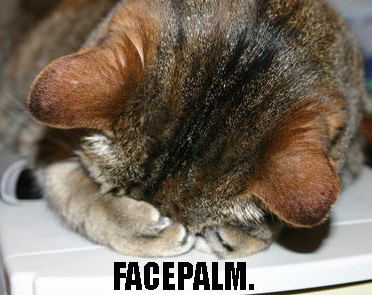
Facepalm cat"I know. You wouldn't.  But--but...I'm sorry, tell me if it's none of my business.  I've been thinking about Sunday night.  It's all I've thought about since...And Gareth said he wondered...Did you...I understand that for you--it's...Was it about ending for you? About the Chantry? About leaving England? About Adam, above all? I know that...But I hope you'll forgive me if I say...And ending, like you said. For you."
Oh, dude, just SPIT IT OUT.  In real life, people might talk like this, but it is terrible on the page.  Stilted and awkward and juvenile.  This is the hero (?)'s big moment, and it's like a first-time hurdler stutter-stepping right out of the gate.  Linguistically, these are so not the people you want to spend 400 pages with.

Ugh.  I could go on.  But there's no point.  Just read the parts with Anthony and Elizabeth and skip all the modern parts because they will suck the patience and life out of you until you look the Cryptkeeper.

This book earned Darwin a PhD in Creative Writing from Goldsmiths College.  This makes me want to bang my head against the wall until it's bloody and then write something better IN MY OWN BLOOD.  Maybe in 10 years.  Once I've finished paying for my Master's.

Monday, March 11, 2013

Worry Birds: 73 Things that Keep Self-Published Writers (Me) up at Night

In the past few weeks, as I adapt to life without Gram, I've been overdosing on writing blogs, social media, and general marketing tips.  I paste everything interesting into Evernote, in notebooks titled "Social Media" and "Website Creation" and "To Do" and "Book Promotion."  

I have 135 "To Do" notes and it makes me feel like I'm going to explode.

Instead of being energized, I'm paralyzed.

I feel like I'm back in 6th grade. There we were, scared and afraid we'd forget our locker combinations.  The first thing my new school had us do is write down all our worries about being very grown-up middle-schoolers on a construction paper bird.  Then we attached our birds to balloons and released them in a big welcome-to-middle-school ceremony.  They were called "worry birds," and by releasing them, we were supposed to let go of our worries, too.  As environmentally unsound as the process is, I feel like I need to do it again.

I'm worried that I will fuck up. I'm worried that I will never, ever be a better or more successful writer.  I'm
worried I'll miss something, fail to do something, and watch my cohorts pass me by.

These are my worry birds:

1. Do I need an author website?

2. If so, where do I host it?  Everyone has an opinion, and as soon as I read a good one about Bluehost, then I read a horror story about them, too. HostGator? LinkSky?  

3. Once I figure out where to host it and buy a domain name, what platform do I use?  The ubiqutous WordPress? Joomla? Impress CMS? Drupal? Does Drupal rhyme with RuPaul, and if so, isn't that kind of a silly name? 

4. Or should I just use Weebly? Are Weebly sites real sites, or are they for non-web people who can't be bothered?  Can I be bothered?  Should I be bothered?  I mean, I'm bothered, but should I bother?

5. How do I organize and design a site that doesn't look cheap, crappy, and templated? I am not a designer nor a programmer. I do not have the money to hire either one.  It's a one-woman show around here, and I work 8 hours a day and do laundry and cook dinner. The hubby would also appreciate it if I worked out more than once a month.  I am not in a good place with love handles right now. 

6. Where will I find the time to produce original content for a website? I don't have enough time to blog and write new stories, let alone put stuff up on yet another site.

7. Don't get me started on a newsletter. People say this is what you need: direct email marketing, hence the  website, hence MailChimp, hence a beautifully formatted, wonderfully written newsletter that I DO NOT HAVE.

8. Do I need WordPress multi-site? As in, an easy way to produce and control multiple websites? Like, one for each book?  Would these each need different looks, themes, content?  Oh, God, content.  

9. "Here are the 248 essential blogs that teach you how to use WordPress." "Here are the 823 plug-ins you CANNOT be without." Are you serious?  I read less informational material in grad school and now I have a Master's.

10. Do I need G+ and Facebook pages for myself as an author, as well as for each of my books? In addition to a personal website? These, of course, also need content.  

11. Do I need to do paper books as well as eBooks?  Do I need to charge more for my eBook so there's less of a  price difference between the two? .99 for the eBook and $9.99 for the paper book just seems stupid to me.  Yes, my eBook is worth more than .99, but pricing low gets volume and readers and reviews, right? 

12. If I do need paper books, which paper book producer should I go with? Xlibris, Book Baby, CreateSpace, Lulu, Autharium, or some as-yet-undiscovered winner? Who has time to research and document the costs, features, and services of each of these vendors in order to make an educated decision?  These are my books.  This is my LIFE.  I cannot afford (literally or figuratively) to fuck this up.

13. Pressbooks? What the hell is Pressbooks?

14. Sales tracking...um, yeah, I don't have that yet.  It would entail downloading month-specific Excel spreadsheets from Amazon that I probably should have been doing all along.  But now I'm behind.  So catching up is hard.  Damn it. 

15. You *are* eating five servings of fruit and veggies daily, aren't you?  And drinking eight 8-oz. glasses of water?  Without whiskey?  As Count Rugen says, "If you haven't got your health, you haven't got anything."

16. Is it worthwhile to pay for a service to advertise the free days you get on KDP?  (Joe Konrath mentions having good luck with eBookBooster, but he's Joe Konrath, making $8,000 a week.)  Also, now that Amazon changed the rules about advertising free days, is this still viable?  Is KDP still viable?

17. Should I take my two KDP-exclusive books off exclusivity and release them through Smashwords, too?

18. Should I be doing more with Kobo?  What *can* I do with Kobo?  Nobody buys my books there, but is it because nobody buys my books there or because I'm not doing anything with it?

19. You mean I need to be in Kobo so I can sell eBooks in real bookstores?  Shit. Shit. Shit.

20. Should I be doing more (read: anything) with Shelfari and Goodreads? Is Boikeno.com the same thing?  And how about BookTalk, KindleBoards, Library Thing, Authonomy, Bibliphil, Booksie,  BookBrowse, Nothing Binding, Filed By, Bookhitch, Scribd, Figment, etc....What are all these places?  Should I use them or ignore them?  How will I remember all the logins and passwords and bears, oh my? 

21. Wait...you mean I have to post fresh content on some of these and then come back and monitor what people say about it? Yeah, sure, I'll do that from 25:00 to 27:00 hours in the parallel universe where I need absolutely zero sleep.

22. You *are* maintaining your LinkedIn page, right?  You *are* posting regular updates, and joining communities, and generally making yourself useful to the twelve writer groups you're in, right?  You're not just deleting those automatic email updates, are you?

23. Why hasn't one of my books sold a single copy since I changed the cover?  This new cover is awesome and the old one sucked. I thought I was doing the right thing.  What gives?  

24. Is there even a point in querying for the novel I just finished?  Querying takes time and rejection takes time and time is what I don't have.  

25. Should my next thriller incorporate characters from my first thriller?  You know, for continuity and increased sales.  They say that helps...but what if I want to create some new characters?  Am I shooting myself in the foot?  What if I'm kind of done with those characters?  Does that mean I created boring, uninteresting characters?  Am I a literary philanderer, incapable of committing to a genre, let alone to a family of characters?  Literary syphilis...is that what awaits me?

26. Is it a waste of time to finish the second romance novel I started, a kind-of-sort-of sequel to the first one I did, since my heart isn't in the genre?  I'm more than halfway through, and one of the best ways to generate readers and sales is to write multiple books in a series, or even in the same genre and I SO DO THE EXACT OPPOSITE OF THAT.

27. When will I have time to research the next thriller, which requires knowledge of French police-type agencies, French cultural institutions, French universities, art theft, and Parisian geography?  I know pretty much nothing about all of these.  Okay, you can delete "pretty much."

28. You *are* using HARO to try and get some free publicity for yourself, aren't you? You're reading the daily emails and querying reporters for any stories you're qualified for, right?  You have a perfectly honed pitch and bio, don't you?

29. What have you done in terms of planning the blog tour for the next book that is soon to be rejected by all agents I plan to approach?  I mean, first I have to design the book, produce the book, make the cover, and plan a to-market date. But really, I need a blog tour.  I need contests.  I need autographed copies to give away.  WHAT?  I HAVE LESS THAN 200 TWITTER FOLLOWERS?  Help me help you...if a tree falls in the forest....insert third cliche here...

30. Should I be buying my own ISBNs?  (I can't afford to buy my own ISBNs.) 

31. "You don't have Google alerts set up for each of your book titles?" 

32. Should I be making Vine videos?  How the fuck does one make a Vine video?  I have a digital camera and a Kindle Fire HD, nothing else.  If push came to shove, I could probably make a tripod with dowels and duct tape.  Would that help?

33. Should I be making book trailers?  My computer came with basic video editing software, but I'm on extremely limited country-ass bandwidth and if I go over 5 gigs per month, the hubby pays for it.  But again, I'm minus the webcam. So that kind of kills that idea, right?

34.  Should I buy a webcam?  (And HD makeup so no one sees the sun damage and zit scars from twenty years ago?)

35. Should I be paying for a template to make a better formatted eBook using Word?  Right now I use the Smashwords nuclear method and it seems fine, but I'm a quality-over-quantity kind of girl and the templates appeal to me even though the ones I looked at are $47/book for paper/eBook template combos.  I do not have $47 x 4 books, fifth coming soon. I do not have InDesign.  I cannot afford to get InDesign.  I fear Pirate Bay.

36. Scrivener?  What in holy hell is Scrivener?  Bartleby, you sick fuck, what are you up to? 

37. How do I get (good) reviews for my comic mystery?  I have some bad ones.  I don't think they "got" it.  Or did I not "get" it?  Oh, crap, what if it's me?  WHAT IF IT'S ME?

38. How do I get anyone to review my historical vampire book?  It's the only thing I've ever gotten a fan letter for, and it has no reviews. The agony.  The humanity.  The feeling that I'm doing something really wrong....

39. When do I find the time to query book bloggers in order to solicit guest posts in order to build my brand and my as-yet-nonexistent website?  I suck at writing query letters.  If I didn't, I might have landed an agent in the first place.

40. "Start by figuring out which book bloggers you share common interests with and connect with them."  SURE.  In my copious spare time.  I'll, like, befriend them all.  Because I'm so good at making friends.  (Did we cover the part where I'm a WRITER?  If I were good with people, I would probably be doing something else with my life.)

41. When am I supposed to find time to follow the 500+ people my trial LittleBird subscription found?  When am I supposed to read their tweets?  When am I supposed to bookmark and then read the 800 websites and posts those tweets recommend?

42. Calibre is what, again?  E-book management software?  What fresh hell is this? 

43. Do I need to hire a photographer to take a few shots of me for the as-yet-non-existent website? My digital camera sucks and I have no Adobe software whatsoever and can't afford to buy any.  I can only traffic on snapshots from 2004 for so long.  

44. BookBuzzr.  Writer.ly.  Might as well learn quantum mechanics while I'm at it.  

45. Instead of producing paper books, is it worth querying small/indie presses directly?  Are you allowed to do this if you've already made an eBook?  What if I yanked the eBook?  

46. Wait, I'm supposed to be currying favor with readers on social media?  Searching for people with keyphrases like "book lovers," "book club, "librarian," "didn't barf when I read Twilight"? When do I find these people, interact with them in a meaningful way, read their tweets and posts, etc.?  Is there a second clock that only really special people have that gives them more hours in the day than I have?  That's it, isn't it?  I knew it.

47. Apps for Facebook that advertise my website?  Do I need this?  Should I?  Wait, first I need a website...

48. Should I use StumbleUpon to help make sure my content is found online?  I have to write content first, remember.  And are you allowed to only Stumble your own stuff?  Isn't that lame?  I don't want to be lame.

49. Fuck, Pinterest.  I need to upload my book covers to Pinterest.

50. Fuck, Flickr.  I need to upload my book covers to Flicker.  Someone somewhere said you get up to 75 keyphrases per image.  75.  I can't think of 75 words right now, except for the ones with four letters.

51.  Fuck.  See, I told you.

52.  No, really, fuck.  What keyphrases should I use in my Flickr images?  Or in general? 

53.  Oh, my God.  Should I be doing AdWords campaigns or Facebook sponsored ads?  Or both?  What landing page do I use?  You can't use a third-party as your landing page, can you?  CAN YOU?  

54. Wattpad?  Is this where James Watt lived?  Unless he invented Visine, I don't give a shit.

55. Writing contests, literary journals, all the regular writing-type submission stuff I did in grad school...you mean I'm still supposed to be doing all that?  You mean I still have to use words like "liminal" and "ontological"?


56.  When are you finally going to get around to using AdWords campaigns to A/B test possible titles for your next book?  Because you SUCK AT TITLES.  And you LACK A LANDING PAGE.  And the money to pay for AdWords.  For the love of God, tell me Blogger is still free.

57. Five essential Twitter hashtags for writers?  I can't even fit what I want to say in the fucking message, let alone leave room for 5 goddamn hashtags. 

58. Which social media management tools will I use?  How the hell should I know?  Fuckers spring up like mushrooms...MarketMeSuite, Seesmic, SocialOomph, CoTweet, Buffer, TwitterFeed, SpredFast, Sprout, Social Flow, AgoraPulse, Ping.fm, Engagio, Hootsuite, Pingraphy, and TweetVisor?  Might as well ask me to explain the difference between Tweedle Dee and Tweedle Dum.  

59. Wait, now I have to make sure my social media outlets "talk" to each other and my website(s) so my updates are blasted everywhere? Isn't that overkill?  Isn't that a duplicate content penalty waiting to happen?  If not now, later?  Panda happened, folks.  Penguin happened.  

60. Writing conferences?  Are you freaking kidding me?  Do you know how much that shit costs?  I credit carded the gas to get to my grandma's memorial service.  Plus, I can't get time off work.  I need money because I have to pay for a mortgage and repay the student loan money I used to go to grad school so I could learn to oh, you know, WRITE.

61.  "800 million sites for Indie Authors."  "5 trillion authors you NEED to know."  "World's Best Marketing Tips Scattered Through These 50 Links Because It's Friday and You're That Lucky."  Dude, by the time Friday rolls around, I don't even know my own name anymore.

62. "Build your brand. Get a logo.  Make your website look like your social media, which looks like your newsletter, which looks like your website."  Did we not cover the fact that I have NO design skills, money, or Adobe software?  Good luck with that.

63.  Understand all copyright laws so you know when you can and cannot use an image in your amateur-ass book cover.  Re-do your amateur-ass book covers, like, eight times because although you can do a lot with PowerPoint, it is no Photoshop.  Which I do not have or know how to use.

64.  What?  You don't have a Google Partner Account?  But to get my eBook on Google Play, I have sell it through my own site.  I do not have my own site.  OH MY GOD, I DON'T EVEN HAVE MY OWN SITE. 

65. Have you crafted a better author bio?  Because, you know, when you *are* the brand, you can't afford to suck.  And you probably suck, you know.  Just saying.

66. You *are* keeping up with your Google+ communities, aren't you?  You *are* making helpful and useful connections and reading everything and commenting, not just +1'ing, right? You need these people.  Be nice to them.  Be responsive.  Read their books.  Leave reviews.  Participate, dammit.  Participate like a motherfucker.

67. You DO have an about.me page, right?  Everyone else got theirs in, like, early 2011.  AND IT'S FREAKING 2013.

68.  Google Reader says I have 18,349 unread items.  All of which contain vital, helpful information I need right now.  Sure, I'll get right on that.  Lemme just grab the toothpicks I use to prop up my eyelids late at night.

69.  NO ONE READS LONG BLOG POSTS THAT HAVE NO IMAGES.  No one.  Don't you know the first thing about content marketing?  Or visual marketing?  Or marketing?  

70.  Wait, I'm supposed to be writing about my own books on this blog and trying to sell them?  But that's embarrassing.  I'd prefer to write about writing and life in general.  Plus I don't know which keyphrases to use.  We covered this, didn't we?

71.  When are you going to write the blog post you started ages ago, about why you don't believe in hiring an editor?  (Sorry, professional editors.)  How many flaming comments will I get for it?  How will I explain that I paid 30 THOUSAND DAMNED DOLLARS for the ability to go to grad school and learn to do it myself?  Did Shakespeare or Milton or Donne pay an editor?  Well, then holy hell, I won't either.  I'll take the responsibility of producing the goddamn best book I can because...I can.  Got a problem with it?  Call my editor.

72.  Someday I'd like to read a book for fun again.

73.  Maybe write one, too. 

Oh, holy Jesus, that's a lot of worries.  I don't have this many balloons.  The balloon factory doesn't have this many balloons.  MAKE IT STOP.  

All joking aside, every single one of these points is a question self-pubbers have to answer.  And then do something about, once they find the answer.  It is exhausting. And liberating.  And scary.   And, at the moment, requiring a liberal dose of whiskey.