Sunday, July 28, 2013

10 Round Gothic Novel Smackdown: Susanna Kearsley vs. Barbara Michaels

10 Round Gothic Novel Smackdown: Susanna Kearsley vs. Barbara Michaels
I love Gothics. I can't help it.

Literary types will wrinkle their noses, but they fulfill a vital purpose in a young girl's reading life: wish fulfillment and escapism. I might not be young anymore, but my head can still be turned by a book description with words like "windswept shores," "unsolved mystery," and "buried secrets."

That's why I snapped up Susanna Kearsley's The Shadowy Horses when Amazon offered the Kindle version for $1.99. But instead of describing all the ways Kearsley's book missed its mark, I decided to compare it to a book called The Sea King's Daughter by an author who has the Gothic style mastered: Barbara Michaels.

Let's take a look at the ways each book delivered or failed to deliver on the promises that are implicit in a good Gothic novel. We have Kearsley in blue trunks and the Michaels in red trunks.

Round 1: Young, pretty, usually naive heroine.

The Shadowy Horses by Susanna KearsleyKearsley: Check (mostly). Verity Grey is an archaeologist who works for the British Museum. She has academic and professional chops, yet still comes across as younger and less experienced than the other archaeologists in the novel. Most, if not all, of the male characters reference how pretty she is, including a ghost and a small boy. This actually gets kind of irritating after awhile.

Bonus: Does the heroine's name have special significance? Yes. "Verity" means "truth." Verity's employer refers to this when asking Verity for her opinion, saying he'd believe her over other less-than-truthful characters.

The Sea King's Daughter by Barbara Michaels
Michaels: Check. Sandy Bishop is a college student who, although she's a great swimmer and diver, isn't a professional treasure hunter. She and her stepfather discovered a Spanish galleon sunk off the Florida coast, but the conditions were such that amateur divers could make the discovery without specialized equipment. Now, her estranged archaeologist father has asked her to come help search for Minoan treasure in Greece. Her naivety comes without question; Sandy is going to college to become a PE teacher, for heaven's sake.

Bonus: Does the heroine's name have special significance? Yes. The very first line of the book is, "Don't call me Ariadne. That's not my name anymore." Sandy's real name is that of a Minoan princess who betrayed her father, Minos, to escape with Theseus after he kills the Minotaur. Unfortunately for Ariadne, Theseus ditches her not long after this. During the course of the book, Sandy finds disturbing similarities between herself and the mythological Ariadne.

Why does this matter in a Gothic novel? Part of the fun of reading a Gothic is seeing how the character fails to see the warning signs of a dangerous situation unfolding around her. She needs to be trusting so she can fall for a dashing but dangerous love interest (see point 3 below). Also, she needs to have somewhere to go in terms of character development. We have to see her getting smarter and being changed by her experiences as the book develops.

Who wins the round?  It's a tie. Verity has special knowledge, while Sandy has a special skill. Verity has made bad relationship choices, Sandy makes some bad choices period. Both heroines are likable, but Sandy stands up for herself a bit more convincingly. Overall, though, there's not a clear edge for either author.

Round 2:  Interesting location in which the heroine feels out of place.

Kearsley: Check. Verity travels to Eyemouth, Scotland, a cold and dreary place that's a far cry from the London hustle and bustle she's used to. She can barely understand the thick Scottish accent, and is constantly having to look words up in a Scots dictionary. It's easy for the reader to picture the generic kind of windswept moors described in so many Gothic novels, but Kearsley adds a great deal of description to help you get a more accurate mental picture of local geography, festivals, and traditions. There are points, however, where the book feels like a travelogue as much as a narrative.

Eyemouth
Eyemouth, Scotland.
Image by Flickr user David Farrer.
Used with Creative Commons license.

Bonus: Do you experience a local festival? Yes. Verity and her love interest, Davy Fortune, attend the crowning of the Herring Queen. The problem with this is that nothing really happens except the festival. I kept waiting for some dangerous incident to occur, but all they did was wander around and remark on how they couldn't wait to make out later. The festival itself wasn't integral to anything that was said or done during that scene. This is bad. Writers: if you're going to indulge in local color, it MUST tie into the plot.

Michaels: Check. Sandy travels to Thera, a Greek volcanic island that was once a stronghold of the Minoans. There's a far more serious language barrier here since Sandy doesn't speak, write, or read Greek. You get a lot of description in this novel, too, but it doesn't weigh down the story like Kearsley's does. The landscape also clearly pertains to the plot since Sandy is helping her archaeologist father look for the remains of Minoan treasure in the island's volcanic caldera.
Thera
Thera, Greece.
Image by Flickr user The Philly Lambs.
Used with Creative Commons license. 

Bonus: Do you experience a local festival? Yes. Sandy witnesses a ritual in which the women of the village carry a saint's image around the town to bless the houses and fields. Michaels does it right by showing the village women making way for one other mysterious woman who comes down from her cliffside villa to attend the festival. Obviously important and held apart from the local peasant women, we take note because the other characters do, too. As Sandy's father joins her, he catches sight of the mysterious woman...and promptly freaks out, fleeing the scene. This WTF moment helps break open the subplot that has to do with the goings-on of the previous generation.

Why does this matter in a Gothic novel?  Part of the fun of a Gothic is escapism combined with wish fulfillment. If you're a bored housewife in Lincoln, Nebraska or a lonely single girl in Bakersfield, California, you'd probably rather read about moors or desert sands or even Asiatic steppes than, say, Chicago. Both Greece and Scotland qualify as exotic locales that pique my interest. Also, Gothics need to take place in an isolated location so the characters have a hard time leaving or running away when the scary shit starts to go down.

Who wins the round? It's another tie. Both books feature an archaeological mystery that's intricately tied to their settings. Both are described so that you feel you're there. Kearsley's descriptions pall after awhile, but they're more lush in general than Michaels, so there's no clear winner.

Round 3: Dashing but dangerous love interest.

Kearsley: In this corner, we have David (Davy) Fortune. That name is so awesome I'm jealous I didn't think of it first. In terms of description, David is tall, broad-shouldered, handsome, dark-haired...a veritable Scottish Heathcliff who actually wears a kilt in one scene. Visually, Kearsley is on track for the win.

However, poor Davy comes up short in the "dangerous" category.  Every good Gothic heroine needs to think that her handsome, stalwart man might also be the bad guy who's trying to scare her away from her goal. Otherwise, where's the fun in that? The relationship needs challenges. In a romance novel, those challenges are usually communication issues or personality flaws in the hero and heroine.  In a Gothic, those challenges need to be based on danger and uncertainty.  The hero needs to walk that fine line between smokin' hot and holy-crap-this-guy-might-be-trying-to-kill-me. Unfortunately, the relationship between Verity and Davy had no challenges whatsoever. It also had very little heat.  A fifth-grader could read this book without getting any untoward ideas.

Michaels: In this corner, we have Jim Sanchez. He's also tall and broad and handsome, with a healthy tan from working outdoors. He doesn't always button his shirt all the way, which is good for Sandy, but also fits with his character. It's hot as hell in Greece in the summer and he's an archaeologist. Plus, this book was written in 1975, when Burt Reynolds and Tom Selleck did this sort of shit all the time.

The "danger" category is also a little light for Jim. However, on a strict one-to-one comparison with David Fortune, Jim takes the cake. At one point, he tells Sandy he'll do anything he can to stop her from diving and looking for Minoan treasure. Of course, he camouflages any nefarious intent by claiming it's for her own safety, but the reader understands there's potential menace there. Also, Jim offers to go swimming with Sandy every day, ditching work to do so. This comes off not as chivalrous, but as creepy. He just wants to be there if and when she discovers something.  This adds to Jim's vague sense of menace. Again, it's not much, but it's more than Davy Fortune gets.

Why does this matter in a Gothic novel? It all goes back to escapism. Women readers want to meet a man they'd fall in love with on the page. That love needs to be tested.  So if they think that handsome devil might actually be a devil, it makes it all the more delicious when the heroine (and the reader) still can't resist his charm and good looks.

Who wins the round?  Michaels.  If it were based on name choice alone, it'd be Kearsley by a landslide. But David Fortune is never menacing in the way a good Gothic hero needs to be.

Round 4: A nurturing father figure.

Kearsley:  Check. It's eccentric millionaire and maligned archaeologist Peter Quinnell, who has spent most of his life looking for the lost Ninth Roman Legion, which disappeared somewhere near Eyemouth. Quinnell is handsome and charming, but most of his colleagues think he's also batshit crazy. Verity starts out thinking he might be nuts, but realizes he misses very little and actually is one of the sharpest guys around.  He's kind to Verity, puts her up in his mansion, really likes cats, and is free with his liquor. I like the guy already.

Michaels:  We have several candidates here.  You could argue that this figure is:
  • Frederick, Sandy's abrasive professor father. He's rude and self-centered, he is teaching her about archaeology and gets really surly when she and Jim are together.  
  • Sir Christopher, an archaeologist digging on the other side of the island. He's antagonistic toward Frederick and takes an interest in Sandy, offering her money so she can get the hell out of Dodge, as well as a job next summer.  
  • Jurgen, a mysterious German colonel who figures heavily in the second half of the novel. At several key points, he seems to be warning Sandy and protecting her against the machinations of his own lover, Kore.  
Why does this matter in a Gothic novel?  For some reason, Gothics usually have nurturing father figures and menacing mother figures. It's all a part of isolating the heroine. You can't give the heroine a dependable best friend or an older female mentor, because then they could help her see past her own naivete. Uh-uh. Not in a Gothic. She can have a kindly older male caretaker or mentor, but when it comes to matters of the heart, this person has to remain clueless.  This is why an older, grandfather-type plays well in these kinds of stories.

Who wins the round?  It's a tie. None of Michaels's characters fit the bill as well as Peter Quinnell does for the Kearsley book, but at the same time, the Michaels story is richer because each of these characters brings a piece of the "father figure" mythology.  

Round 5: A mysterious and menacing older female figure.

Mrs. Danvers from Rebecca is the OG
when it comes to the menacing older
female character in Gothic novels.
Kearsley: There's a menacing and vaguely mysterious female figure, all right, but she's younger instead of older. Her name is Fabia, and she's Peter's granddaughter. She's not a professional archaeologist like Verity--she's just lending a hand for her grandfather. She stays out late, dislikes Verity, and has it out for Peter because she feels Peter loved archaeology more than Fabia's father (Peter's son). Verity never quite trusts her, which is smart. However, Fabia doesn't do any of the traditional menacing things, like tell the heroine, "You need to leave for your own good or bad things will happen to you."  Although Fabia does pose a danger late in the novel, by then, it's really hard to give a crap.

Michaels: We've already mentioned Kore, the strangely alluring older woman who comes to the village festival and freaks everyone out. She's actually the mistress of a mysterious German colonel who lives in a fancy villa up on a cliff above the village. She is not German, however; she is Greek. This brings up a lot of loyalty issues for the older village folk, for whom World War II wasn't that long ago. As the book goes on, Kore gets more and more mysterious. At one point, she walks straight up to Sandy and warns her to get lost. What does she know that Sandy doesn't? Later in the book, Kore takes care of Sandy after an accident. She chants, goes into trances, watches Sandy while she's sleeping, and lets weird guests into the villa during the middle of the night. Yes, this qualifies as menacing and mysterious.

Why does this matter in a Gothic novel?  The menacing female is very important. You have to fight fair, and as a writer, it's a little unfair to pit a big, strong man against a tiny, seemingly defenseless female. It's fine to hint that the big, strong man is out to get her, but usually, the villain or villain's assistant is a woman. This way, it's a fair fight when the heroine gets to take her down. Plus, it's very traumatizing for a woman to read about a woman being victimized by another woman. We're used to reading about glass ceilings or horrible male bosses or terrorists/kidnappers who are male. But when our heroine is put down or led astray by a fellow woman? That's disturbing on so many levels.  After all, as Madeline Albright said,
"There is a special place in hell for women who don't help other women."

Who wins the round? Michaels. Fabia, Kearsley's antagonistic character, never really gets up to much menace until it's too late to care. Kore gets kind of annoying toward the end of the Michaels book, but I'd take annoying and mysterious over Fabia's annoying and...just annoying.

Round 6: Incidents of danger that warn the heroine away from her current course of action.

Kearsley: Nope. Not even close. There's no actual villain, violence, or conflict for most of the novel. (Note to Kearsley: Are you kidding me?) This is what irritated me most about the book.  A couple times, objects sort of move around, presumably at the hand of a ghost.  But although the Sentinel is creepy, this ghostly Roman soldier never harms anyone. Most of the characters never even interact with him.

In addition, there are no accidents sabotaging the dig, no one warning the archaeologists to stop looking for the Ninth Legion or else, nothing remotely sinister. No one wants to steal the treasure, stop the excavation, or harm any of the participants. Mostly it just rains and people stop work to go inside, pet cats, and get drunk. Not a single character's physical safety is endangered until the final chapter, when the ridiculous climax and denouement occur. This makes for a pretty boring read, especially in a book that seems to hew so closely to many other Gothic tropes. One character, whose fey son can see and talk to the ghost, tells Verity to stop using the boy to communicate with the ghost, but there's no hint of the "or else" that every good Gothic needs. Writers, you can't build a strong plot without conflict and an antagonist. I can't believe the Kearsley book was such an epic fail on this account.

Michaels: Check. We've got spies, rockslides, booby traps, errant gunshots, a kidnapping disguised as a rescue, drugging, and more. There are a buttload of reasons why Sandy needs to say sayonara to her father's dig, but in traditional Gothic fashion, she stays.

Why does this matter in a Gothic novel? The stakes have got to increase as the book goes on. Verbal warnings can only go so far. The villain needs to do things that make the heroine fear for her life. This not only makes it more interesting for the reader, but it also gives the heroine a chance to show her mettle.  Unless she's tested, how will she develop as a character?

Who wins the round? Michaels. No contest.

Round 7: Events that seem to be supernatural.

Kearsley: This started out well. There's a ghostly Roman soldier haunting the dig site. He's called the Sentinel, and seems vaguely menacing. The only person who can see him or hear him is a little boy, Robbie, the son of Peter Quinnell's housekeeper.  Robbie is a little disturbed by some of the encounters with the ghost, and there's one creepy scene where Verity feels the ghost near her in her office. But for the most part, the ghost is benign. In fact, the ghost's true intentions are revealed a little too early, if you ask me. Overall, the supernatural peters out without providing much more than a bit of atmosphere and a hint of conflict for the ghost whispering boy's father, who thinks he and his son are being used by the uppity archaeologists.

Michaels: This started out well, too. Sandy, who has never been to Greece, starts having weird living daydreams where she knows she's been to some of these places before. She sees an artifact in a Greek museum and knows its purpose, sees herself using it in the past. There's some mysterious connection between Sandy, her father, the legends of Atlantis, and the destruction of Crete. There's also a local female-based cult that mixes elements of Christianity with earlier pagan beliefs, including the idea of ritual sacrifice. Although all of these elements seem like they should be tied together, they don't really coalesce in the end. In the first part of the novel, Sandy's seeming past-life experiences play a large role. They don't in the second, and the novel ends with a weak return to them that doesn't really explain anything. Writers, if you can't explain something that seems supernatural, don't include it. Tie it to your plot, provide hard details of how it's happening, or forget about it.

Why does this matter in a Gothic novel? It makes shit interesting. Again, it's all about upping the ante and giving the heroine more than she can handle. Not only does she need to sort out her feelings for the hero and deal with the antagonistic female in her life, but now she's supposed to deal with ghosts? Jesus, our heroine says. Give a girl a break.  But we can't, because that's how books work.

Who wins the round? It's kind of a fail-tie. Both authors introduce supernatural elements that aren't really explained and tied to the on-the-ground events well enough.

Now, there are a few characteristics of both books that aren't necessarily de rigeur for Gothics, but that merit additional comparison:

Round 8: An archaeological mystery.
19/365+1 What did the Romans ever do for us?
Plaque on the spot where the Ninth
fled Boudicca's army in 61 AD.
Image by Flickr user Dave Crosby.
Used with Creative Commons license.

Kearsley: Check. The Ninth Roman Legion marched deep into the north of England to subdue the warlike border tribes. They vanished sometime between 108 AD, when they rebuilt the fortress at York, and about 150 AD. They were never heard from again. It's a damn good premise, and made me seek out more information about the historical mystery. The book doesn't really solve the mystery one way or another, which is to be expected based on the set-up. Because the mystery still exists, Peter Quinnell can hardly claim to have found conclusive proof that the Ninth was massacred on the Scottish border (although that's what the book hints at).

Minoan palace at Knossos, Crete
Ruins of the Minoan
palace at Knossos, Crete.
Image by Flickr
user inis22mara.
Used with Creative
Commons license.
Michaels: Legend says that the lost city of Atlantis fell into the sea, somewhere in the Atlantic. But what if Atlantis were really in the Mediterranean? What if the mystical city were really a garbled representation of the fate of the Minoan civilization? A cataclysmic volcanic eruption in about 1500 BC destroyed the Minoan civilization on Crete and Thera, a thousand years before Plato described Atlantis in his writings. Frederick and Sandy are looking for artifacts that might be buried under the water, proving that a magnificent city did fall into the ocean, and that Atlantis can and should be identified with the Minoans.

Who wins the round? Tie. These are both awesome archaeological mysteries to explore. Both authors provide information about the mystery's set-up as well as tidbits that have been uncovered to support or detract from the characters' theories.

Round 9: Nightmares of the heroine.

Kearsley: Verity dreams that she hears horses' hooves pounding the ground outside her window. But no one else hears the horses, and when she finally mentions it, everyone confirms that there are no horses on the grounds that could possibly have made the noises she heard. Ghost horses! Cool, right? Unfortunately, the nightmares don't lead her to any conclusions, and don't really represent anything. Are they supposed to be the ghosts of Roman horses? Do they mean the Ninth is really there, at Eyemouth? Verity doesn't come to either of these conclusions. It's a huge missed opportunity for Kearsley. Plus, it's also the title of the damn book, so you'd think it would mean a little more.

Michaels: Sandy dreams that she's in the Labyrinth with the Minotaur. She watches Theseus follow Ariadne's ball of string to the center of the maze, where he'll face off against the nightmarish creature (half-bull half-man). The dreams are extremely vivid, pretty well done, and creep Sandy out. They cause her to identify with her real name, Ariadne, and make her see the connection between Ariadne and herself: will she betray her father for Jim the way Ariadne betrayed her father, Minos, to run away with Theseus?

Who wins the round? Michaels. The dreams actually tie into the symbolism of her name and the mythology behind it.

Round 10: The sins of the fathers. 

Kearsley: Yes, the doings of the previous generation come back to bite the heroine's generation in the butt. I won't say how, in case you want to read the Kearsley. But there is a secret that leaks, and it leads to the only real incident of physical danger for anyone in the whole book. Still, that being said, the secret isn't really that big deal, and the reveal feels minimal and lame and rushed. Plus, neither the secret nor the reveal has a damn thing to do with the archaeological mystery or the ghost. It's just crap the characters have to sort through.

Michaels: Yes, the doings of the previous generation come back to bite the heroine's generation in the butt. In fact, there's an entire subplot involving Frederick, Sir Christopher, Jim's uncle (a cohort of Frederick and Sir Christopher's), Kore, and Jurgen. Because this book takes place in 1975, the previous generation's escapades took place during World War II and involve the resistance movement against the Nazis on Crete. There's something hinky between Frederick and Kore, and we find out that someone betrayed someone else  to the Nazis all those years ago. Yeah, that's pretty kick-ass.

Who wins the round? Michaels. Come on. Weak drawing room intrigue or a World War II resistance movement?

Okay, after 10 rounds, it's time to crown a winner!

Rounds tied: 5
Rounds to Kearsley: 0
Rounds to Michaels: 5

Now, this isn't to say the Michaels book is perfect. It's not. It has some pretty big flaws in the second half of the book. However, it kicks the crap out of Kearsley's limp, dreary, soggy tale. The winner is Barbara Michaels.

10 Round Gothic Novel Smackdown: Barbara Michaels, Winner

Friday, June 28, 2013

Writer, Edit Thyself: Why You Shouldn't Hire an Editor (Yet)

You need an editor to fix your plot, pacing, and grammar? Tell me again what a great writer you are.
I've been reading a lot of writers' blogs and posts in writers' communities on G+. One thing I keep seeing is the recommendation (commandment, from some) that all indie writers must hire an editor before (a) sending work to an agent, or (b) self-publishing.

I understand where this advice is coming from, but...I have a big problem with this. And this is from someone who earned her highest salary EVER as a professional editor. (Feel free to laugh at this. My bank account does.) I know a few editors, and most of them are incredibly nice and talented people. I have nothing against them. I do have something against lazy writers who can't learn on their own.

If you ask me, the solution isn't to hire someone to make your writing better. It's to make it better your own damn self.

Suck at editing? Learn.
Suck at grammar? Learn.
Suck at revising? So do lots of people. Guess what? They fucking learn.

Anything worth doing is worth doing well. If you can't commit the time to learn how to use the English language well enough to pass muster with a reader, are you really cut out to be a writer? Or do you just like the cheap thrill of how easy it is to tell a story?  There's nothing wrong with storytelling. But it's only half of your toolkit.  You can't buy the other half.  Okay, maybe you can. But it's lazy and wrong and I'm going to berate you for it.

Objection #1: But as a writer, I'm too close to my story to see its flaws.
Bullshit. Read some books. Is yours like theirs? If so, you're doing it right. Sit down and make a list of the kinds of things that happen in good books. See the story arcs? Diagram your own story arc. Is there an arc? There are all kinds of story arc tools you can use before you write your story to make sure it's plotted and paced well. If you have any analytic capability at all, apply it at this stage in the game. If you don't have any analytic capability at all, you might not be cut out for writing. If you have analytic capability but this sounds like a hell of a lot of work, you're damn right. Stop reading blog posts and go diagram your damn book.

Objection #2: But I've read my manuscript so many times that my eyes glaze over the typos.
Bullshit. Read it out loud. Read it backwards. Print it out and look at it on paper. Put it in a drawer for a month and come back to it. None of these are impossible tasks unless you refuse to devote the necessary time. Are you refusing to devote the necessary time? Are you short-cutting what I hope is the most important thing in the world to you when you're doing it? If you have a nervous feeling in the pit of your stomach, if your cheeks are red, or if you're thinking of other things you should be doing right now, you're who I'm talking to. Don't ignore it. Embrace it, and then get it done. It might lengthen your production schedule to include a cooling-off period and then final proofing, but that's not my problem. It's yours.

Objection #3: But I'm just not good at grammar. I need someone to fix a few commas and things.
Bullshit. If you're not that good at grammar, how are you crafting sentences that shock and awe? How are you being careful when you pick your verbs? How are you playing with language to create the precise effect you want in a reader's mind? Or are you just whizzing through it all, using descriptions you've read in books because it's easier that way? Doing shit like this gets you nowhere. I read the jacket copy for a self-published romance novel where the author actually wrote that the dangerous and intriguing mystery man knocked the heroine's world on its axis. I kid you not. This is the kind of writer I'm talking about.  I saw a second writer who tried to convince me of a character's ability to deploy "feminine whiles." These people need to become better craftsmen. Right now, they're just swinging hammers with a blindfold on and hoping they hit a nail.

Objection #4: But editors need money. I have the money. What's the problem?
This is a slippery slope that often ends in bullshit. Replace "editors" with "prostitutes." Are you really doing this out of the goodness of your heart for your editor? Don't use this as an excuse not to learn to revise or proofread yourself.  Trust me.  We editors are a skilled and wily bunch. We'll survive.

Books aren't written, they're rewritten: Michael Crichton quote
What do you think...would Michael Crichton have appreciated
being immortalized on a purple gingham background?
Objection #5: But I need someone who will push me to do better.
Bullshit. If you want to do better, you can and you will. If you have the desire to become a better writer, don't do it by hiring someone to tell you why you suck.  That's stupid.  Figure it out yourself so you're not dependent on an editor for every book you write. It's like this:  "Give a man a fish and he eats for a day. Teach a man to fish and he eats for a lifetime."  Teach yourself to fucking fish.  Do it by reading, experimenting, writing more, getting critiques from friends and beta readers, then rewriting again and again until you've produced something that leaves them speechless.  And then you can hire an editor for that extra 10% of effort that gets you to the full 110%.
An editor can be a part of that solution, but only a part, and only after you've exhausted every inner working of your soul that can go into the creation and recreation of your book.

Tip: A really good creative writing professor once told me that the best way to learn how to write good stories is to copy a great story out by hand. As you write the other writer's words, you'll absorb how they flow and how they're put together. You'll be forced to slow down and really read the story.  He suggested doing this with Flannery O'Connor. Have you done this yet? I didn't think so.

Objection #6: Why do you hate people so much?
As Bukowski said, "I don't hate people. I just feel better when they aren't around."

If you love writing, great. So do I. But doing only the fun parts is like what a five-year-old does when she strews toys all across the living room, plays with one or two of them, and then abandons the mess to go play outside. Or when you cook a great meal, eat it, and then leave dirty dishes lying everywhere. No, it's not fun to clean them. But paying someone else to do it because it's a difficult or distasteful task is cheating.

Think of the great writers of history: Homer, Sophocles, Chaucer, Shakespeare. They learned their shit and they learned it well. Yes, guys like Hemingway and Fitzgerald received editing from their publishers...only once they had turned in a manuscript that was as honed and polished as they could get it. They didn't slap-dash anything the page, do a Microsoft spellcheck, and hire someone to make sure it wasn't a mess. They agonized and revised and revised again. Your agony level needs to be somewhere north of poison-oak-in-your-nether-region. If you're at lemon-juice-in-hangnail stage, you're not nearly there yet.

Yes, beta readers can be helpful. As the book's writer, you cannot approximate a first-time reader's experience (unless you become psychic or telepathic). But fixing commas and quotation marks and hyphens and holes in your plot an elephant could fit through simply because you can't learn how to do it yourself?

Give me a break.  You can do better.  (Have I mentioned I love memes?)
Writing better: challenge accepted meme

Wednesday, May 29, 2013

Reasons to Be Cheerful

I'm amazed by how hard it is for me to write a happy post. I am naturally inclined to think the sky is falling if I don't have everything on my worry bird list checked off. And I don't....NOT EVEN CLOSE. Stressing out is sort of a natural state of being for me as an indie writer. 

At the same time, I realize that you guys probably don't want to read dark and bitchy posts all the time. Sometimes we (and I mean me) have to take a step back and look at the things that are going right to keep from freaking out over the things that aren't going at all. So queue up the player below, which contains the official soundtrack for this post: Ian Drury's Reasons to Be Cheerful, Part 3.


How to Be Happy (When You Still Have 8 Damn Million Things to Do)

Jenni's sparkle shoes
Now with more sparkle!
1.  Look at that sky. It's not actually falling. Heck, it's not even raining. 

2.  Your shoes are cute. 

3.  Hey, your necklace is cute, too. 

4.  All of your fingernails are intact. 

5.  You submitted to 10 literary journals over the weekend. That's 10 chances to kick ass.

6.  You entered your first-ever YA novel in a contest to win a publishing contract. That takes balls.  Whether you win or lose or just make it through to the second round and then lose, you still have a brand-spankin' new book done and ready to go.  If you want to read it (and vote for it!), click here

7.  You are planning your first-ever urban fantasy novel. You've always wanted to write something that combines your favorite writing subjects: hicks and the supernatural. Don't stress about how long the planning and research is taking. Be happy that you'll get to fulfill a goal by writing this book. Use it as an excuse to say "y'all" even more often. Plus, it means you get to watch Justified and Duck Dynasty and this and call it research. 

8.  You're working now. So what if 3 out of 4 of your eBook covers still suck? Set aside some money and pay to get new ones. Then market with confidence.  In the land of eBooks, nothing is permanent. It can always be fixed or upgraded. It's just money. Why do you have it if not to use on on something that's really, vitally important to you?

9.  Your husband loves you.  And he wants you to spend your money on book covers if that's what will make you happy.  And he is going to tile the kitchen floor. And he will come all way across the house when you yell, "Spider!" 

10. There are lots of cute puppies in the world. You don't have one, and probably never will, but that doesn't mean the world is a lesser place.  

11. You have learned so much about marketing as a writer in the past few months. It makes you feel like you're eight hundred years behind schedule, but that's only because you're comparing yourself to others. You are you. You know what you need to do. That's all that matters.  

12. Have you seen the view from your deck?
Beautiful Pilot Hill, California
Not a painting, no sirree. This is genuine Pilot Hill awesomeness.

Tuesday, May 14, 2013

Book Review: Angelopolis by Danielle Trussoni

Angelopolis by Danielle Trussoni
The characters I know and loathe
are at it again in Angelopolis.
If you read this blog regularly, you know that the first book in this series, Angelology, earned my undying loathing for its failure to capitalize on a near-brilliant premise. Well, that and some of the worst writing I've ever read in a book praised by everyone from the New York Times to USA Today. Clearly there was some Kool-Aid going around and everyone became insane for a brief period of time in 2010.  

Well, this time I was much smarter about things. I didn't spend my own money--I patronized my local library. There's one more sliver of good news here: I didn't loathe it quite as much as the first one. If the first book received a grade of F from me, this one's a D.  It might just be because instead of 450 mind-numbing anger-inducing pages, this one's a scant 300. Let's see how it shakes down, shall we?

Spoiler-free summary:
The heroine of the last book, Evangeline, is an angel (we learned this at the very end of Angelology). Verlaine, her love interest, has become an angel hunter and spent the last 10 years looking for her. Yes, we have jumped 10 years forward in time. Why? God knows. Two or three years would probably have sufficed. Verlaine and Evangeline have a brief run-in that convinces Verlaine he is in love with her. Evangeline is kidnapped by another angel, working for the Grigori family (angel bad guys), but not before she slips Verlaine a Faberge egg. Verlaine and Bruno, his angel hunting mentor, must figure out what the egg means and where Evangeline has been taken.

WTF spoiler-filled summary:
drawing of the Panopticon
Grad school asshats
always mention the Panopticon
when they want to seem smart.
The angels are trying to build themselves a city and take over the planet. Apparently, some Nephilim descendants used to give birth by laying eggs. People came out of these eggs, I shit you not.  Egg births have become quite rare, although they are desirable for the higher-quality angelic offspring they produce.  Queen Victoria is a Nephilim descendant and, by extension, Empress Alexandra of Russia. Alexandra had an egg birth that occurred during what history has recorded as a phantom pregnancy. Alexandra was actually impregnated by the archangel Gabriel and so the resulting egg-child (Lucien) is of a purer angelic strain than ordinary Nephilim. There is some huge angel prison in Siberia, modeled after the Panopticon of Jeremy Bentham. It blows up in the end. Oh, and there's an angel vaccination of sorts, which could turn an angel or a Nephilim human again.  It can only be made once due to the rarity of one of its ingredients. The angel hunters made it, and Verlaine hands it over to Evangeline, thinking she will quaff it, but no, she steals it and leaves to hang out with Lucien, who is actually her father. Verlaine gets pissed and instantly wants to kill her (again). He gets voted as the leader of the next round of angel/Nephilim resistance fighters. The end. My head hurts.

Things that Didn't Suck

1. Angelopolis was shorter than the first book.  This represents an attempt on the author's part to keep the plot more tightly controlled. It also meant the whole thing gets over with faster.   

2. The Romanovs were peripheral characters. Ideas that link real people and historical events to mythological events are cool.

3. It created some interesting mythology about the Biblical flood, Noah, the Ark's location, and what exactly got preserved on that Ark. Those are all the nice things I can think of to say.

Things that Sucked

1. The author still seems to believe that long-winded explanations and backstory and plot setup can take up 70% of a book without the reader getting bored. It is DISASTROUS. In the quote below, a co-worker of Dr. Azov, an angelologist, asks a visiting angelologist named Vera if she needs a refresher on the kind of work Azov does before meeting the good doctor:  
"No need," Vera said. "I know that Azov has occupied the center on St. Ivan Island for over three decades--since before I was born. His outpost was created in the early eighties, when a body of research pointed to the presence of well-preserved artifacts under the Black Sea. Before this, angelologists stationed in Bulgaria worked near the Devil's Throat in the Rhodope mountain chain, where they monitored the buildup of nephilim and, of course, acted as a barrier should the Watchers escape." (p 136)
Holy mother of God, if the answer to someone's question is a simple "no," just say "no."  

2. The dialogue is tragic. It's artificial at best, and often used to deliver complicated history lessons. This makes the characters themselves seem even more wooden than they actually are. Here's one stellar example of tragic dialogue:
"Absolutely certain," he said. "And I'm not the only one--an angelologist is hunting her at this very moment. An angel hunter." 
How could we fail to be aware of the fact that an ANGELOLOGIST who is HUNTING her is an angel hunter?  At what point in the second sentence is this unclear enough to need a third?


Image of the Joker from Batman writing "Why so serious?" in blood
3. The tone and sentence structure never change. A five-page digression into angelology and a motorcycle action scene are treated exactly the same way, and this does a disservice to the few action scenes. It gives the book a plodding feel. 

4. There is no humor whatsoever. This series takes it itself so goddamn seriously.  Even books and shows that deal with the end of the world need a little humor. Supernatural does this amazingly well.  You can't have DANGER DANGER BIBLICAL WEIRDNESS RASPUTIN DANGER LECTURE ON BIBLICAL WEIRDNESS OMG WORLD ENDING PANOPTICON THE END without a moment or two of levity. People are not robots. I found myself seeking an escape from this book, which is theoretically entertainment, and thus supposed to be an escape. Epic fail.   

5. The characters are flat. They aren't allowed to do or say anything except spout Trussoni's "big ideas" about history and angelology. They don't have favorite foods or favorite colors or get bitten by bugs or hate their shoes or express real-life opinions about anything non plot-related. They don't have thoughts about past loves or wives or girlfriends or boyfriends or past experiences that reveal who they are. They are plot devices, not people. This is the closest to characterization you get:
He would be forty-three years old in less than a week and he was in the best condition of his life, able to run for miles without breaking a sweat.  (p 35)
6.  The writing is flat.  Everything is told, never shown. We are simply told what characters feel. They do not express it or show it. It gets boring. So very boring. Apparently, Trussoni graduated from the Iowa Writer's Workshop. Coulda fooled me.
"You want to re-create paradise," Angela said, astonished.
Someone who's good at writing wouldn't have needed to explain the bad guy's shtick, and could have used a gesture or body language to convey said astonishment. Here's another awesome example:
There was a rusty Zid motorcycle parked nearby, its wires hanging loose. The engine was vastly different from his Ducati, but in a matter of seconds, he'd hot-wired the bike, thrown his leg over the leather seat, and was speeding after Eno. (p 125)
Hmm. In addition to the multiple "was" verb forms making this theoretically exciting chase scene boring, this passage begs several logistical questions. If Verlaine has a Ducati, how is he intimately familiar with the workings of a Zid engine? What the hell are the wires doing hanging loose in the first place?  Wouldn't the owner, like, I don't know, fix that shit?  And how, pray tell, does one hot-wire a motorcycle? A bit of authenticity here would have helped. At least YouTube it and try and find out how it's done.
As Verlaine followed Angela's movements, he realized that his entire body had gone rigid. (p 82)
In the above, why wouldn't you simply say, "Verlane's body went rigid"? All of the "following" and "realizing" dilute the power of the physical effect Trussoni is trying to create. This is bush league, people.
From the way she looked at him, he could feel her rage. (p 178)
And again, we have the bush league version of telling, not showing.  How did she look up at him? What was in her eyes, in her body language?

7.  Some of the facts are not right.
Could have been a simple typo, but the book gives 1917 as the Romanov execution year. Nope.  Also, when mentioning the Romanov execution, she talks about them going out "into the cold."  Um, it was July. And hot as Hades. Not sure anything would have been cold. Minor quibbles, I know, but they exist.

desk flip rage because of how incredibly bad Angelopolis by Danielle Trussoni is
I give up. I fucking give up.
8. The sheer ridiculosity of the egg birth thing. I just don't buy it.  Nephilim lay eggs?  Like, an egg actually grows in the woman and she gives birth to it?  Does it then hatch immediately?  Or does it friggin' incubate in a bassinet? And I'm supposed to believe Peter the Great came out of an egg?  All Trussoni says is, "...how such a birth had come to pass was never documented" (p 221). Wow, convenient, huh? But if the ranks of European royalty are littered with Nephilim, what happened in the days when many royal births were public? Did the woman know in advance whether she'd give birth to an egg or a baby?  How could all the ladies-in-waiting and midwives who were present at egg births throughout history have been silenced? This just has too many logistical weirdnesses to it.  I can't suspend my disbelief that far. And who said angels have egg babies? They aren't birds.  Birds evolved from dinosaurs. Did angels evolve from dinosaurs, too? Again, I am confused.  If the author has thought through the answers to these questions, they need to be shared.  In a way that doesn't involve eight pages of lecturing dialogue. But this is what we get:
Verlaine stole a look at Vera, wondering how all of this was striking her. It seemed that her dubious theories about Easter eggs and royal egg births could be supported by the tsarina's collection. (p 104) 
WTF? Because the Romanovs had Faberge eggs, they MUST be nephilim?  I have a carving of an elephant on my bookshelf.  Does that mean I'm half pachyderm?

9.  The sheer ridiculosity of the idea that Empress Alexandra and her daughters had wings. That she taught them to fly on lazy afternoons in the Crimea. I mean, really.  If anyone had wings, it would have been Felix Yussupov, right?  And isn't it extremely likely that some one in the Romanov entourage would have seen crap like this?  Again, how were these witnesses silenced? Even when on "vacation" at Livadia in the Crimea, there was still an enormous household of servants, tutors, cooks, ladies in waiting, and friends.  It strains credulity that this could have happened. And let's think a little harder about this...if they did have wings, how likely is it that they would have been held prisoner for so long?  Especially toward the end, after the rescue attempt failed?  Couldn't they have flown away from the Ipatiev house?  It boggles the mind. But, no, in the author's world, this is legit:
She spent hours grooming her great pink wings. She would use her leisure time teaching her daughters to fly in the private garden of their country estate in the Crimea. (p 112)
10. I'm still not clear on *why* the archangel Gabriel chose to impregnate Alexandra. What was so important about that time, that situation? It's important for the world-building and mythology, but it was glossed over.  I mean, why not impregnate Anne Boleyn?  Surely she prayed just as hard for a son as Alexandra. What was so important about Alexandra and Russia and that moment in time?  We are never told. 

11.  Trussoni is incredibly bad at building a believable relationship. Verlaine and Evangline are cardboard characters, so it's impossible to take them seriously when they try to feel things.  Like love.  Verlaine runs the gamut from "I hate her, I want to kill her" to "Maybe she's not so bad" to "I freakin' love her" to "I hate that bitch."  The words fly out of his mouth and it feels random because there is no establishment of his emotional history.  Here's the big moment when Evangeline and Verlaine have some Jedi mind-meld moment of togetherness as they escape from danger:
He was sure that all of the thoughts and all of the desires that he'd ever felt had collected in his heart at that moment. (p 290)
So glad he's sure.  Wouldn't want any of those stray, unnamed thoughts or desires getting away from him now.

12. The number of times she uses the phrase "as if" to describe things that are happening is staggering.  Witness the following examples: 
The entire structure had the appearance of a ruin, the light fixtures crude, as if the building had been wired for only the most basic functionality." (p 151)
 It was as if they all felt that a solution was possible, that once they made it to Valko they would overcome the seemingly impossible odds. (p 175)
 ...a second blast of searing heat seized her, this one more intensely painful than the first, as if her skin had been peeled away in one clean sweep. (p 258)
ONE PARAGRAPH LATER 
...the moment Vera woke it seemed to her that she had died and emerged on the other side of existence, as if Charon had in fact taken her across the deathly river Styx to the banks of hell. (p 258)
 ONE SENTENCE LATER
Her body felt stiff and hot, as if she had been dipped in wax. (p 258)

The Takeaway
This book is a flop. There is no deft or beautiful language, no metaphor, nothing of note linguistically. It's just a weird-ass confusing story, told with little grace or charm and absolutely no hint of humor or spark or real life.

Tuesday, April 23, 2013

8 Signs You Are Not the Chuck Norris of Writing

As a writer, you're a target. You're putting yourself out into the world and asking both readers and ubiquitous Internet heroes to comment on your work.

Some of these folks are looking to take you down, to give you a bad review, to tell you you don't know what you're doing. They are the Kim Jong-uns of the Internet: puffy, whiny, self-important, and probably in need of a kick in the pants. As a writer, the last thing on earth you want to do is give these people ammunition. You want to be the Chuck Norris of writing, the one-man-army capable of telling a legion of disbelievers to go straight to hell: Vaya con Chee-Tos, mothertruckers.

One of the best ways to do this is to make sure your fundamentals--your phrasing and grammar--are correct. Many writers skip this step, preferring to rely on their storytelling ability to carry them through the process. But this would be like Chuck Norris skipping all the other color belts that lead up to a black belt. Did Chuck Norris skip out on the yellow belt or the purple belt? I think not. He mastered that shit because he's Chuck Norris.  You can do the same.

One more note, before we dive in: Chuck Norris would never use Microsoft's grammar check. He knows it's wrong half the time. He ignores it, and you should, too. Chuck Norris learned how to write by reading.  A lot. And more than just kung-fu how-to manuals. Chuck Norris reads classics, sci-fi, historicals, biographies, and oh yes, even a vampire book or two.  If you want to learn to write like Chuck Norris, you need to read out of your pay grade. 

In any case, Chuck and I offer this starter kit of 8 stupid mistakes never to make with your writing. Some of these are actual mistakes I've seen in books, many self-published. Go forth and conquer.   

1. You use turns of phrase without actually knowing what they mean. 
  • "...the change knocked her world on its axis..."  This is not correct. An axis is an imaginary line around which an object (presumably a planet) rotates. When something incredible happens to your character, her world cannot be knocked ON its axis. It was there to begin with. Her world may, however, be knocked OFF its axis.  
  • "...step foot in..."  This is everywhere. People say it, but it IS NOT RIGHT. The phrase is "set foot in." It might make sense at first because "step" is a logical word to combine with "foot." But the sense in which it is used is totally wrong. To "step" automatically implies you are using your foot, which makes the use of the word "foot" stupid and redundant. To "set" does not automatically imply you are performing this action with a foot; therefore, it is reasonable that you then specify "foot" after the verb.  
  • "...she thought to herself..."  Unless your character is telepathic, there is no way she could "think" to anyone else.
2. You use adverbs when the verb you use already implies that adjective. 
  • "...tripped clumsily."  Can you trip in a way that's not clumsy? Even if you can, is that what your character is doing?
  • "...shouted loudly."  Is it even possible to shout quietly? If it is, "shouted" is the wrong damn verb.
  • "...jumped quickly."  Let's see you jump slowly. I dare you to try. I dare Chuck Norris to try.
3.  You use adverbs too much in general. We all know adverbs are to be used sparingly. But occasionally, they creep in and that can be okay. But it's not okay when you're using an adverb because it's easier and faster than describing how a character does something. You're a writer. You're supposed to be describing how characters do things. That's your job. So do better at it. Here are some examples of lazy adverb use:
  • "You murdered my nephew," he said angrily. Really? Because I always thought proclamations of murder were issued joyfully. Gosh, wouldn't it be nice if the punctuation could somehow reveal the character's emotion? If only someone had invented a single punctuation mark that conveys strong feeling.
  • "Constantly stepping from foot to foot, Joe looked nervous." In this case, the adverb is unnecessary. Stepping from foot to foot already implies the motion is constant. 
  • "Moving slowly through the graveyard..." If your verb requires an adverb for the reader to get the picture, you picked a shitty verb. 
4.  You misuse prepositions.  Oh God, the prepositions. They are under attack. I don't know how this happened. It's like waking up one day to find out that all the streets have been renamed and now you have no idea what people are saying when they're trying to give you directions on how to get to the grocery store. And you're like, "Man, all I wanted is some mac and cheese. Why are you making it so hard?" Don't make it hard on your reader. Prepositions are the street signs that tell your reader where your sentence is going. If you don't use the right street sign, your reader is lost.  And lost people get angry. Sometimes they get murdered by drifters. Do you want your readers to get murdered by drifters? Don't answer that. Like Blair Waldorf, I rely on plausible deniability.
  • "...ponder on..."  You ponder something. You don't ponder on it. If you tell me you're pondering on a Corvette, I will imagine you perched upon a car, thinking about a subject you failed to specify.
  • "She was ignorant to the fact that he was an ex-con."  She ain't the only one. You can be ignorant of a fact, but not ignorant to it. There's no easy way to learn this stuff. You just have to read good books and absorb these idioms.
  • "...disappointed from..."  You can be disappointed by the fact that you died from dysentery, but you cannot be disappointed from the fact that you died by dysentery.
  • "She glanced on her watch."  A glance is not a tangible thing, so it cannot actually be on the watch. She may, however, glance at her watch.
  • "You can never go wrong on fruits and vegetables."  I BEG TO DIFFER. You can go very, very wrong. In order not to go so wrong, try going with them instead of on them.
5.  You use descriptive dialogue tags. You've probably seen Elmore Leonard's advice for writers, one point of which states that you should never use anything other than "said." 98% of the time, he's right. There is rarely a case when you need to use a dialogue tag. If you use one, you're following the same lazy pattern of writing indicated by adverb use. Your dialogue, in combination with the motion of the character in the scene, should tell the reader how that line is spoken. If you have to specify with a dialogue tag, you haven't effectively conveyed the feeling of the scene, the emotion of the character, or his or her mindset. 
  • "Eww! I hate spiders!" she shrieked. The problem with dialogue tags is that they are often unnecessary. The exclamation points tell you this character has strong feelings about spiders. She is probably angry or afraid, and you as the writer should provide the context to tell us which it is. Using both exclamation points and a tag such as cried/shrieked/wailed/exclaimed is overkill.
  • "And the best part is...I never pressed play!" he cackled.  I call C+C Music Factory on this one. A cackle is a laugh, right? Can you actually speak all these words while cackling? Or is the laugh coming between the words? Or did the cackle come after, in which case the words themselves were not "cackled"? Or is the laugh really even a cackle to begin with? Do you see what kind of problems a poorly thought out dialogue tag can get you into? 
6.  You get subject-object agreement wrong. This is a tricky one, but once you know what to look for, you'll see it everywhere. Remember, no one's asking you to speak properly. You don't have to obey this rule when you're talking to your mom or your wife, but you do have to obey it on the page. Because if you don't, someone who does know the rule is going to put down your book and think, "Amateur." And by someone, I mean Chuck Norris.
  • "Americans who love The Fast and the Furious live their life a quarter mile at a time." What's wrong here? The subject of the sentence is "Americans." You're making a statement about a large group of people. But you used the word "life," which is not plural. Do all Americans live one life?  Apparently not, since "One Life to Live" was canceled. See? Even ABC figured this shit out. Now it's your turn. You want to say that Americans live their lives a quarter mile at a time. Now you're cooking with gas.
  • "One cannot have their cake and eat it, too." You would think that a word like "one" is enough to tell you that it means "one."  As in singular. As in not plural. So who are all these other folks you've invited into your sentence by using "their"? Is your "one" a schizophrenic? Are you a schizophrenic? If not, shape this shit up by keeping this a party of one: One cannot have one's cake and eat it, too.  
7. You use semicolons. Badly. You do not know how to use them, yet they appear throughout your book. Why is this? Do you randomly sprinkle mathematical formulas throughout your book just because they look intellectual and important? That's what lots of people do with semicolons. They look fancy, and probably imply that your sentence is multi-layered and complicated....right? No. Just...no.  If you can't tell me the rule for semicolons, right now, don't use them. Ever. Until you learn the rule, which is this:
  • One rule to rule all the rules: Semicolons are used to separate TWO COMPLETE THOUGHTS. If either part cannot stand on its own as a grammatically correct entity, DO NOT USE A SEMICOLON. Chuck Norris will hurt you if you do this. If there's one thing Chuck Norris hates, it's bad semicolon usage. Don't believe me? Try it, and then go to sleep. See if you wake up.
  • "One time at band camp; I did things my mom wouldn't approve of." A semicolon is not a comma. These two thoughts are clearly connected, but they cannot stand on their own.  "One time at band camp" is not a sentence...it is the beginning of a sentence.  And yes, I know that sentence ended with a preposition. Some rules were meant to be broken. Deal with it.
  • "Rochelle had more to do that Saturday night; more than get wasted." Again, the second half of this sentence is placed for emphasis--it is not a sentence in and of itself. Only the cheese stands alone. Sentence fragments are not cheese.
8.  You confuse the most basic contractions you learned in first flippin' grade. I'm serious. Now you've got Chuck Norris *and* your first grade teacher really pissed at you. Is that what you want? He'll hold you down and punch you while your first grade teacher spits in your face. Or just drags her nails along the chalkboard. That's no one's good time. So do the world a favor and just learn what six-year-olds in good schools already have.
  • For the last time: the apostrophe means it's a contraction. Contraction means two words are smashed together tighter than Kim Kardashian's boobs in a bustier. Some of the letters got kicked out because they couldn't breathe. The apostrophe tells us those letters are missing and someone might want to find them someday. Or not. It's up to you. 
  • You're/your.  You're going to get your ass kicked by Chuck Norris for fucking this up. If you cannot replace the word with "you are," you should use "your."
  • It's/its. It's a damn shame the snake left its home and decided to sleep in your bed instead. If you cannot replace the word with "it is," you should use "its."
  • Their/they're/there. They're late for their own funeral because Chuck Norris got there first. 
If you're seeing some of your own mistakes listed here, now you have the power to fix them. This is progress! If you're not seeing any of these mistakes in your writing, look harder. Look even harder still. And then, if you still don't see these mistakes, congratulations on possibly being the Chuck Norris of writing. I salute you.

Monday, April 8, 2013

Book Review: A Secret Alchemy by Emma Darwin


Based on the jacket copy, this book is right up my alley: it combines the historical mystery of the Princes in the Tower with two historical narrators involved in the drama (Elizabeth and Anthony Woodville) and a modern narrator, a historian named Una.  The jacket copy promises the book is "a brilliant feat of historical daring."  Suffice to say it falls short both of brilliance and daring.
A Secret Alchemy by Emma Darwin
The narrator would NEVER HAVE WORN
A COAT THIS CUTE. I feel misled.
Also, this cover has nothing to do with the book.


All three narrators' stories are interwoven, presumably to illuminate each other. The modern narrator, Una Pryor, belongs to a large family that owns and operates a press housed in a medieval chantry.

(Digression alert.  Chantry is a weird word, isn't it? A former friend once told me a terrible story about a dentist named Chantry.  Something about mold growing in someone's head?  Gross, n'est-ce pas?  I still like the word, though.)  

This part of the story follows Una and her repressed, noncommunicative family as they struggle to figure out how to keep their small press in business despite aging family members, scattered younger family members, and financial concerns.  You'd think they were Swedish the way they refuse to ask questions or say a single thing they're thinking.

The two medieval narrators, Anthony and Elizabeth, tell the story of the Woodville family from their precipitous rise to power when Elizabeth married Edward IV to the rise of Richard III and the murder of two of Elizabeth's sons in the Tower as a part of Richard's power-grab. These historical narratives are done relatively well, except for the gimmick of spelling the names differently in the medieval narrative and spelling them in modernized fashion in the modern narrative (Antony/Anthony; Elysabeth; Elizabeth). Despite the spelling issues, Anthony and Elizabeth are sympathetic and layered.  They need a lot more room to play.  They might have been able to save the book had they been the only ones telling the tale.

The Worst Part
The modern narrator is a disaster.  She is passive, weak, scattered, and stupendously uninteresting.  Unfortunately, she carries most of the book.  She is a hand-wringing sort, the kind who sighs with unhappiness and bemoans her state when a simple question, spoken out loud, would solve everything.  She makes a big deal about being exhausted and tired when she hasn't done very much but sit in a car as a passenger and worry about things.

I wanted to steal things from her just to watch her DO something as she hunted for them.

An Also Pretty Bad Part
But the weird structure and shifts in tone and tense are what killed the book for me. The whole purpose of interspersing modern and medieval perspectives should theoretically be to illuminate similarities in us despite the hundreds of years in between. But the two time periods are only loosely connected, and Darwin makes little effort to provide any sort of illumination.  The modern characters fluff around in self-indulgent heaps, while the medieval characters get less page time despite the fact that the cosmos basically hands their collective ass to them, which is much more interesting.

Elizabeth Woodville
Elizabeth Woodville: hot or not?
Una, the modern narrator, is theoretically writing a book about the books of the Woodvilles.  You'd think the character might actually try to find out what they are, or read them, and think about them.  Nope.  She mentions one or two titles, but doesn't do more than go visit a couple of the locations the Woodvilles found themselves in, and then whine about how she can't "find" them in these places.  Really, she just pines over a guy who worked in her family's chantry and then shows up again to help them save it.  And pining makes her so tired, so then she just has to rest.  It was almost halfway through the book before I realized Una might be, like, 50?  60?  Not really sure.  Never confirmed.

The Weakest Link
Una is the weak link that destroys any real, lasting, emotional connection between our time and the Woodvilles.  She's the weak link full stop, as the Brits say.  Does she bother to make connections about her family losing their press and chantry as the Woodvilles lost their father, brother, and nephews during the upheavals of the War of the Roses?  Nope.  Does the widowed Una bother to connect herself to Elizabeth, widow of Edward IV?  Maybe once.  In a sentence.  Does she bother to think for even a moment about Anthony Woodville (here, in love with a man) and her uncle Gareth (a closeted gay man)?  What they might have shared in their experience?  Nope.  Too much trouble, apparently.  Takes away from valuable time spent pining and whining and wringing her hands.

Lego tree
The cheater tree.
In the end, Una thinks she might write a biography instead of a scholarly work on the Woodvilles' books.  But what on earth has she learned about them?  She finds a letter written by one of them that purports to clear up that whole what-happened-to-the-Princes-in-the-Tower thing, touted as the focus of the book on the jacket.  It gets a couple of sentences.  That's it.  And then the annoying-ass narrator thinks she's awesome for being in the right place at the right time to have someone hand her the letter, and decides to write a biography when she never really tried to write the scholarly book in the first place.  UGH.  It's like watching a kid think about trying to build a house out of Legos and then give up and stick the Lego tree on the green Lego base board instead.  Because it's easier.  And because they found the tree in the box.  DONE, MAN.  I NAILED THAT SHIT.  LOOK AT MY LEGO TREE ON THIS NICE LEGO BASEBOARD.  I DOUBT YOU COULD HAVE DONE BETTER.

Oh, God, There's More?
The book also has another one of my pet peeves--present tense.  Una's story is told in present tense, but it has so many friggin' flashbacks in the first half of the book, that half of the present tense ends up being in past tense anyway.  JUST USE PAST TENSE.  Present tense adds nothing.  Absolutely nothing.  All it does is confuse the living hell out of the bored reader who suddenly finds that Una has slipped yet again into a reverie.  This woman should never be allowed to drive a car or operate heavy machinery.  It's like narcolepsy of the soul.  Surely there is a medication to deal with this.

But How's the Writing?
The prose is stilted and hard to read for its sheer lack of fluidity.  To wit:
"As I eat, I can't help but watch Mark. His plate's on the ground in front of him. Even with his knees bent up, his legs cross more of the rug than any Pryor's ever would. He looks up, our eyes meet.  Even if he'd reached out his hand--his beautiful, long-fingered hand--and actually touched my cheek I couldn't be more shaken.  What is this heat? Memory's powerful. But this, is this about the past?  I was grown up by then and talking to Mark, working with Mark, referring to Mark, had all become easy enough, because the paths for that were well laid. The longer what I knew--thought--felt--went unspoken, the more manageable it was, and even the despair became a settled thing, a known quantity, a thick, stable layer at my core. I even sometimes thought he'd forgotten what I'd said, and sometimes thinking so hurt more, and sometimes it hurt less."
Oh, holy crap. This is just too much.  We have present tense.  We have past tense.  We have the ridiculous contraction of "memory's powerful."  We have some amorphous shift into the days when she dreamed about Mark. We have the a question asked of no one in particular.  It's like a twelve-year-old girl trying to use a fifty-year-old woman's language.  It just doesn't work.

They Don't All Talk Like That, Do They?
It's not just Una who talks like this.  It's her would-be beloved, Mark, too.  Here's what he says during their great love scene:
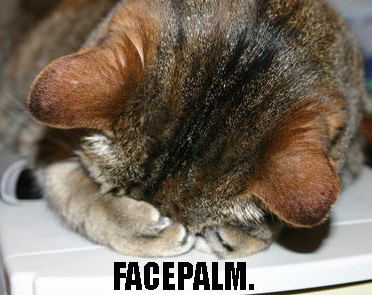
Facepalm cat"I know. You wouldn't.  But--but...I'm sorry, tell me if it's none of my business.  I've been thinking about Sunday night.  It's all I've thought about since...And Gareth said he wondered...Did you...I understand that for you--it's...Was it about ending for you? About the Chantry? About leaving England? About Adam, above all? I know that...But I hope you'll forgive me if I say...And ending, like you said. For you."
Oh, dude, just SPIT IT OUT.  In real life, people might talk like this, but it is terrible on the page.  Stilted and awkward and juvenile.  This is the hero (?)'s big moment, and it's like a first-time hurdler stutter-stepping right out of the gate.  Linguistically, these are so not the people you want to spend 400 pages with.

Ugh.  I could go on.  But there's no point.  Just read the parts with Anthony and Elizabeth and skip all the modern parts because they will suck the patience and life out of you until you look the Cryptkeeper.

This book earned Darwin a PhD in Creative Writing from Goldsmiths College.  This makes me want to bang my head against the wall until it's bloody and then write something better IN MY OWN BLOOD.  Maybe in 10 years.  Once I've finished paying for my Master's.

Monday, April 1, 2013

Cover Me: Why I Finally Paid for a Work of Art

I may have been wrong about some stuff. Hey, it happens.
The Romanov Legacy by Jenni Wiltz
The Romanov Legacy: Kindle Edition

If you're self-publishing and seek out any advice at all on the subject, you'll run into two ironclad recommendations in a hurry: pay for a professional cover and pay for professional editing.  

I never took either of these seriously, for several reasons:

1.  I have no money.  For three years, I lived on $800/month.  BEFORE TAX.  I went back to work full-time six months ago, largely because now I have $30K of student loans to pay back.  Money is tighter than the space between my back molar and my wisdom tooth.  (Another thing that might be able to be fixed, had I some money.)

2.  I disdained the idea of paying for something I could theoretically do myself. After all, I have a brain and two college degrees.  I've read books and judged them by their covers all my life.  How hard could it be to design one, right?  Software is the great democratizer, putting tools into the hands of people with time and a willingness to learn.  I could be the living, breathing representation of this principle.  

So that's what I did for four books.  Then something changed.   

I just paid for my first-ever professionally designed cover, and I'm over the moon about it.  It's an updated cover for my spy thriller, the one that sells best out of my four. What on earth led to this epiphany?  

The credit is entirely due to the blog The Book Designer. Well, let's be honest...one post on the blog The Book Designer.  

When I found this post, where he evaluates covers uploaded by self-pubbed authors, I had my Eureka! moment.  It was actually a Eureka! moment combined with the mental equivalent of a walk of shame.

Okay, so I suck at covers. But the
lower left photo is my great-grandma!
That's cool, right?
Reading through the brutally honest comments ("unmistakably amateur," "confused and indecipherable," "visually weak"), all I could imagine was what he'd say about mine:

  • Beginner's font.  
  • Terrible colors.  
  • Poor spatial arrangement.  
  • Can't see a frickin' thing...it's all too dense.
All this time, I'd been thinking I could be Superwoman and do it all.  Politely worded suggestions (nay, commandments) weren't strong enough to reach me; I could still brush them off.  But specific examples of constructive criticism aimed at efforts clearly on my level were things I couldn't ignore. 

So I scanned my Google+ writers' communities, looking for recommendations and availability. I worked with a writer/artist whose covers I'd seen and liked. One weekend later, the top image is the result. One weekend. 

Now, this huge chore is now lifted off my shoulders. I'd been wondering...do I fork out for a month of Adobe Cloud service to get access to Photoshop and Illustrator and try to learn that shit in one month during the free trial? But that would mean one month of constant trial and error, with no time for writing. What if I couldn't get something usable in that month? I'd have to pay for another month ($50-$75) or abandon everything I'd already done. Argh.  

Now it's all solved. I love this cover. It's simple, beautiful, and effective in conveying to the reader the main points of the book:

  • The angel image symbolizes Belial, the heroine's schizophrenic hallucination.  
  • St. Basil's Cathedral in Red Square symbolizes Russia, which is not only a setting, but a cultural flashpoint.  Ivan the Terrible, Bolsheviks, Communists, New Russia...these are all facets of the book, and the simple cathedral image conveys all this at a glance.  
  • The fonts are also legible at a glance, with words big enough to read when browsing Kindle listings.  The fonts convey a sense of urgency, with the scrawl of "legacy" beneath the majestic presence of "Romanov."  
Some people just get how to do cover art.  Now that I've realized I'm not one of them, I feel free.  Yes, I have to cough up money to have this done.  But when I thought of it as a cost per hour, I would have been working for about $1 an hour if I tried to do it myself.  Is that the best use of my time?  Hell, no.  I need to write.  

So in terms of a time investment, paying for a cover is a huge savings.  Plus, now I have something I can be proud of to display in my marketing materials.  I'm building a Facebook fan page and a Google+ page for this book, all featuring this cover.  It's inspired me to do more and do it better.  Talk about money well spent.  

But I'm still not paying for editing.  The reasons for that are for another post entirely.